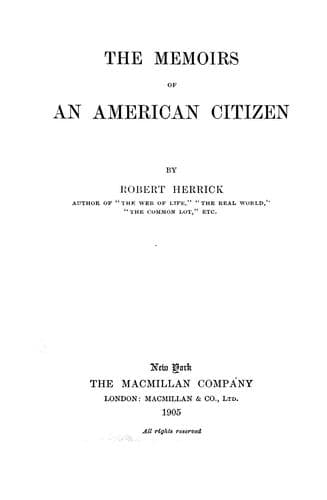
Capitalists and financiers -- Fiction; Chicago (Ill.) -- Fiction; Meat industry and trade -- Fiction; Political fiction
The girls and the boy, Dick, paid him even less respect than they did
their mother. They were all the kind of children that don't tolerate
much incompetence in their parents. Dick was a putty-faced, black-haired
cub, who scrubbed blackboards and chewed gum in a Board of Trade man's
office. Neither he nor his two sisters, who were also working downtown,
contributed much to the house, and except that now and then Grace, the
older one, would help clean up the dishes in a shamefaced way, or bring
the food on the table when the meal was extra late or she wanted to get
out for the evening, not one of the three ever raised a finger to help
with the work. The whole place, from kitchen to garret, fell on poor old
Ma Pierson, and the boarders were kinder to her than her own children.
Lank and stooping, short-sighted, with a faded, tired smile, she came
and went between the kitchen and the dining room, cooking the food and
serving it, washing the dishes, scrubbing the floors, and making the
beds--I never saw her sit down to the table with us except one Christmas
Day, when she was too sick to cook. She took her fate like an Indian,
and died on the steps of her treadmill.
There were two other regular boarders besides myself and Ed--a man and a
woman. The latter, Miss Hillary Cox, was cashier in the New Enterprise
Market, not far from the house. She was rather short and stout, with
thick ropes of brown hair that she piled on her head in a solid mass to
make her look tall. She had bright little eyes, and her rosy face showed
that she had not been long in the city.
The man was a long, lean, thin-faced chap, somewhat older than I was.
His name was Jaffrey Slocum; he was studying law and doing stenographic
work in a law office in the city. When I first looked at him I thought
that he would push his way over most of the rocks in the road--and he
did. Slocum was a mighty silent man, but little passed before his eyes
without his knowing what it meant. I learned later that he came from a
good Maine family, and had been to college in the East. And he had it
much on his mind to do several things with his life--the first of which
was to buy back the old home in Portland, and put his folks there where
they belonged. Old Sloco, we called him! For all his slow, draggy ways
he had pounds of pressure on the gauge. He and I have fought through
some big fights since then, and there's no man I had as soon have beside
me in a scrap as that thin-faced, scrawny-necked old chip of Maine
granite.
* * * * *
When Ed introduced me at the table, Grace made a place beside her, and
her sister Lou hospitably shoved over a plate of stew. Then Lou smiled
at me and opened fire:--
"We read all about you in the papers this morning, Mr. Harrington!"
"Heh, heh!" Pa Pierson cackled.
"Say, Lou, I don't call that polite," Grace protested in an affected
tone.
"Don't mind me," I called out. "I guess I'm a public character, anyway."
Public-domain text, read in full here on John Shaqi.
Reviews
Reviews
No reviews yet
Be the first to share your thoughts on this work.
Join the Discussion
Join the discussion
Sign in to leave a comment or review.
Sign InorCreate an account