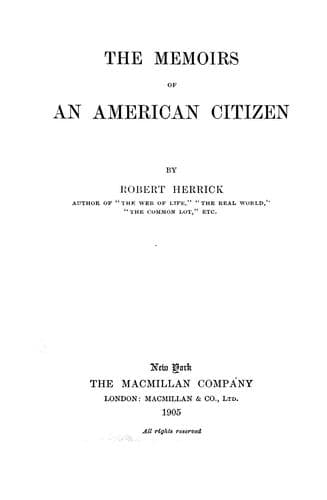
Capitalists and financiers -- Fiction; Chicago (Ill.) -- Fiction; Meat industry and trade -- Fiction; Political fiction
What was the golden road? These men had found it--hundreds, thousands of
them,--farming tools, railroads, groceries, gas, dry-goods. It made no
matter what: fortunes were building on every side; the flowers of
success were blooming before our eyes. To take my place with these
mighty ones--I thought a good deal about that these days! And I remember
Grace saying sentimentally to Slocum that Sunday:--
"You fellers keep thinkin' of nothin' but money and how you're goin' to
make it. Perhaps rich folks ain't the only happy ones in the world."
"Yes," Hillary chimed in, "there's such a thing as being too greedy to
eat."
"What else are we here for except to make money?" Slocum demanded more
bitterly than usual.
He raised his long arm in explanation and swept it to and fro over the
straggling prairie city, with its rough, patched look. I didn't see what
there was in the city to object to: it was just a place like any
other--to work, eat, and sleep in. Later, however, when I saw the little
towns back East, the pleasant hills, the old homes in the valleys, and
the red-brick house on the elm-shaded street in Portland, then I knew
what Slocum meant.
Whatever was there in Chicago in 1877 to live for but Success?
CHAPTER V
A MAN'S BUSINESS
_Signs of trouble at the Enterprise--A possible partnership--He
travels fastest who travels alone--John Carmichael--Feeding the
peoples of the earth--I drive for Dround_
"Do you see that big, fat fellow talking with Mr. Joyce?" the cashier
whispered to me one morning as I passed her cage. "He's Dround's
manager--his name is Carmichael. When he shows up, there is trouble
coming to some one."
Dround & Co. was the name of the packing firm that the Enterprise dealt
with. I tied up my bundles and made up my cash account, thinking a good
deal about the appearance of the burly manager of the packing-house.
Pretty soon Mr. Carmichael came out into the front store very red in the
face, followed by the elder Joyce, who had been drinking, and they had
some words. The cashier winked at me.
The Enterprise had been doing a good business. It was run on a new
principle for those days--strictly cash and all cut prices, a cent off
here and there, a great sale of some one thing each day, which the house
handled speculatively. The brothers Joyce kept branching out, but there
wasn't any money to speak of behind the firm. The Drounds and a
wholesale grocer had backed it from the start. Nevertheless, we should
have got on all right if the elder Joyce had given up drinking and the
younger one had not taken to driving fast horses. Latterly no matter how
big a business we did, the profits went the wrong way.
That evening, as Hillary Cox and I walked over to the Piersons', she
said to me abruptly, "There's going to be a new sign at the Enterprise
before long!"
The smart little cashier must have divined the situation as I had.
"Cox's Market?" I suggested jokingly.
Public-domain text, read in full here on John Shaqi.
Reviews
Reviews
No reviews yet
Be the first to share your thoughts on this work.
Join the Discussion
Join the discussion
Sign in to leave a comment or review.
Sign InorCreate an account