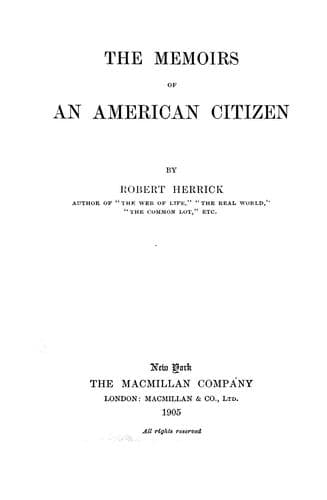
Capitalists and financiers -- Fiction; Chicago (Ill.) -- Fiction; Meat industry and trade -- Fiction; Political fiction
In front of our office a brougham was drawn up--an unusual sight at any
time, and especially at this hour. It was standing close to the door,
and as I picked my way through the crowd I looked in at the open window.
My eyes met the eyes of a woman, who was leaning against the cushioned
back of the carriage. She was dressed in a white, ruffled gown that
appeared strange there in the yards, and her eyes were half closed, as
if she were napping or thinking thoughts far removed from the agitated
city. But when I came closer she gave me the sharpest look I ever saw in
a woman's eyes. It was a queer face, dark and pale and lifeless--except
for that power of the eyes to look into you. I stopped, and my lips
opened involuntarily to speak. As I went on upstairs, I wondered who she
could be.
My desk was just outside the manager's private office, and, the door
happening to be ajar, I could see Mr. Dround within, striding up and
down in great excitement. Carmichael was trying to quiet him down. I
could hear the chief's high, thin voice denouncing the anarchists:--
"It is a dastardly crime against God and man! It threatens the very
foundations of our free country--"
"Yes, that's all right," big John was growling in his heavy tone. "But
we don't want to make too much fuss; it won't do no good to poke around
in a nest of rattlers."
"Let them do their worst! Let them blow up this building! Let them
dynamite my house! I should call myself a craven, a poltroon, if I
wavered for one moment in my duty as a citizen."
Carmichael sighed and bit off the end of a fat cigar that he had been
rolling to and fro in his mouth. He seemed to give his boss up, as you
might a talkative schoolboy.
Henry Iverson Dround was a tall, dignified gentleman, with thick gray
hair, close-cut gray whiskers, and a grizzled mustache. He always
dressed much better than most business men of my acquaintance, with a
sober good taste. The chief thing about him was his manners, which, for
a packer, were polished. I knew that he had been to college: there was a
tradition in the office that he had gone into the business against his
will to please his father, who had begun life as a butcher in the good
old way and couldn't understand his son's prejudices. Perhaps that
explains why all the men in the house thought him haughty, and the other
big packers were inclined to make fun of him. However that might be, Mr.
Dround had a high reputation in the city at large for honorable dealing
and public spirit. There was little set afoot for the public good that
Henry I. Dround did not have a hand in.
I had met the chief once or twice, big John having called his attention
to me, but he never seemed to remember my existence. To-day Mr. Dround
blew out of the manager's office pretty soon and brushed against my
desk. Suddenly he stopped and addressed me in his thin, high voice:--
"What do you think, Mr. Harrington, of this infernal business?"
Public-domain text, read in full here on John Shaqi.
Reviews
Reviews
No reviews yet
Be the first to share your thoughts on this work.
Join the Discussion
Join the discussion
Sign in to leave a comment or review.
Sign InorCreate an account