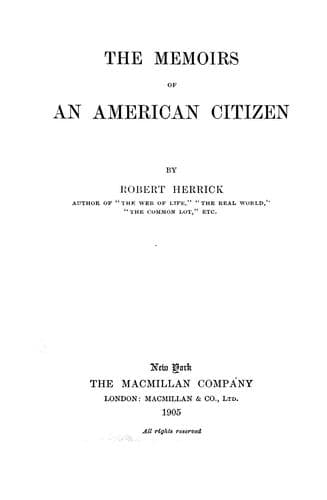
Capitalists and financiers -- Fiction; Chicago (Ill.) -- Fiction; Meat industry and trade -- Fiction; Political fiction
This is scarcely the place to tell the story of that famous trial. It
has kept me too long as it is. The trial of the anarchists was an odd
accident in my life, however, which, coming, as it did, when I had my
foot placed on the ladder of fortune, had something to do with making me
what I am to-day. Up to this time I had never reflected much upon the
deeper things of life. The world seemed good to me--a stout, hearty
place to fight in. I had made money in the scheme of things as they are,
and I found it good. I wanted to make some more money, and I had little
patience with the kickers who tried to upset the machine. But I had not
reasoned it out. There in the court room, and later shut up in the jury
quarters, day after day, cut off from my usual habits, I thought over
some of the real questions of our life, and made for myself a kind of
philosophy.
To-day, after the lapse of eighteen years, I can see it all as I saw it
then: the small, dirty court room; the cold, precise face of the judge;
the faces of the eight men whom the police had ferreted out of their
holes for us to try. There wasn't much dignity in the performance: some
pretty, fashionably dressed girls sat up behind the judge, almost
touching elbows with his Honor. They came there as though to the play,
whispering and eating candy. There was the wrangling among the lawyers,
snarling back and forth to show their earnestness. But my eyes came back
oftenest to the faces of those eight men, for whose lives the game was
being played. Two were stupid; three were shifty; but the other three
had an honest glow, a kind of wild enthusiasm, that came with their
foreign blood, maybe. They were dreamers of wild dreams, but no thugs!
From the start it seemed plain that the State could not show who threw
that fatal bomb, nor who made it, nor anything about it: the best the
State could do would be to prove conspiracy. The only connection the
lawyers could establish between those eight men and the mischief of that
night was a lot of loose talk. His Honor made the law--afterward he
boasted of it--as he went along. He showed us what sedition was, and
that was all we needed to know. Then we could administer the lesson. Now
that eighteen years have passed, that looks to me like mighty dangerous
law. Then I was quick enough to accept it.
Public-domain text, read in full here on John Shaqi.
Reviews
Reviews
No reviews yet
Be the first to share your thoughts on this work.
Join the Discussion
Join the discussion
Sign in to leave a comment or review.
Sign InorCreate an account