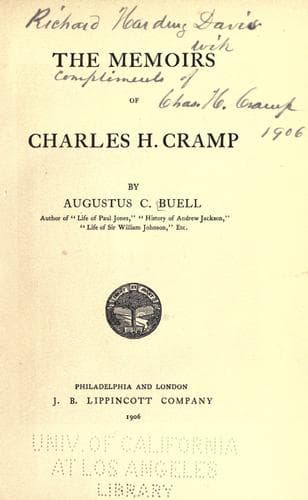
Cramp, Charles Henry, 1828-1913; Naval architects -- United States -- Biography
Since 1887, a period of sixteen years, Mr. Cramp has completed fifteen
ships for the navy (including the “Vesuvius” and “Terror”), and is
building three more at this writing. In every case these ships embody in
plan and design more or less of his own knowledge, skill, and
experience. In some cases the designs are altogether his own. In others
the machinery is his, with important modifications of the Department’s
hull. In no case has he built a ship wholly upon the plans of the
Department. While this has redounded to the benefit of the navy, it
would be idle to say that it has been in the long run advantageous to
Mr. Cramp. On the other hand, its tendency has been otherwise: A certain
class of naval officers have chosen to consider Mr. Cramp’s constantly
recurring propositions to modify and improve their designs as having the
force and effect of criticisms, and, to say the least, they have not
been grateful to him for his pains. On the contrary, no little jealousy
and some resentment have been the results, and he has been made to feel
their consequences more than once. The chief misfortune of this state of
affairs is that it precludes the cordial co-operation which should exist
between officers of the Navy Department and a contractor engaged in
building naval vessels, and creates in its stead a sense of antagonism
which tends to augment the difficulties of naval construction, which are
great and perplexing enough at the best.
But Mr. Cramp has not concerned himself with the building of naval ships
alone. He has delved into the problems presented by the uses to which
the ships are put when completed. The results of his observations in
this direction were embodied in an address to the Naval War College read
before that institution, June 18, 1897, by invitation of the Commandant,
a little less than a year before the Spanish War. The experience of that
struggle, brief as it was, and decided almost wholly by sea power, made
this paper little short of prophetic.
Some extracts from it will serve to exhibit the trend of Mr. Cramp’s
thought in the direction of the practical uses and needs of ships-of-war
after they leave the ship-builder’s hands. Among other things he said:
“The accomplishment of the objects of sea-warfare will depend partly
upon the character of the armaments and partly on the wisdom with
which their operations are directed; nor can any one gainsay that
the wisdom of direction will depend on the conversancy of officers
with the nature and necessities of the material units of which the
armaments are composed.
“These propositions being taken for granted, it becomes clear that
there can be no effective system of teaching the art of naval
warfare which does not embrace exhaustive study of and consequent
close familiarity with the instruments by which the principles of
the art are to be carried into force and effect.
Public-domain text, read in full here on John Shaqi.
Reviews
Reviews
No reviews yet
Be the first to share your thoughts on this work.
Elsewhere in the archive
Join the Discussion
Join the discussion
Sign in to leave a comment or review.
Sign InorCreate an account