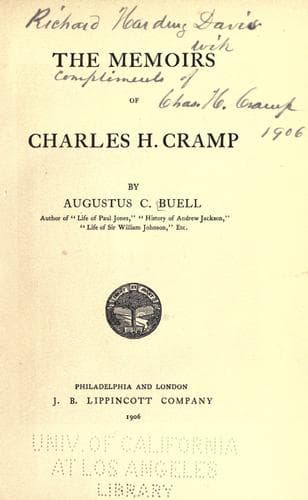
Cramp, Charles Henry, 1828-1913; Naval architects -- United States -- Biography
“From this point of view it must be admitted that questions within
the province of the naval architect and problems which he is best
qualified to solve form an essential part of such a curriculum in
its largest and most comprehensive aspects.
“The unvarying tendency of naval progress is to exalt the importance
of the naval architect and to augment the value of the constructor
as a factor in the sum-total of sea power.
“The naval armament of to-day is a mechanism. If we view it as a
single ship, it is a mechanical unit whose warlike value depends on
its excellence as a fighting machine. If we view it as a fleet, it
is an assembly of mechanical units, the warlike value of which will
depend alike on the excellence of each unit as a fighting machine,
and on the adaptation of each unit to its consorts to produce the
most symmetrical efficiency of the group as a whole.
“For this reason, the word seamanship, in the old-fashioned or
conventional sense, has ceased to cover adequately the requirements
of knowledge, skill, and aptness which the modern conditions of
naval warfare impose upon the officer in command or subordinate.
“By this I mean not to depreciate seamanship pure and simple, but to
point out that modern conditions require an enlargement of the
meaning of the term and a broadening of its scope of function far
beyond the exactions of any former period.
“In the old days there was no essential difference in ships except
in size. Experience in a sloop-of-war qualified an officer to
assume, at once and in full efficiency, equivalent duties in a
frigate, a seventy-four, or a three-decker. Familiarity with one
ship, irrespective of rate, was familiarity with all ships. Tactical
lessons learned in manœuvring one fleet were alike applicable to the
manœuvring of all fleets. Even the application of steam as a
propulsive auxiliary in its earlier stages did not radically alter
the old conditions. At all events, it did not practically erase
them, as the present development has done.
“This growth of complexity and elaboration, and this almost infinite
multiplication of parts and devices in modern ships, have entailed
upon the naval architect and constructor demands and difficulties
never dreamed of in the earlier days. The staff required to design
and construct an ‘Iowa’ is multiplied in number, and the complexity
of its organization augmented, as compared with that required for
the design and construction of the ‘New Ironsides,’ almost
infinitely.
Public-domain text, read in full here on John Shaqi.
Reviews
Reviews
No reviews yet
Be the first to share your thoughts on this work.
Elsewhere in the archive
Join the Discussion
Join the discussion
Sign in to leave a comment or review.
Sign InorCreate an account