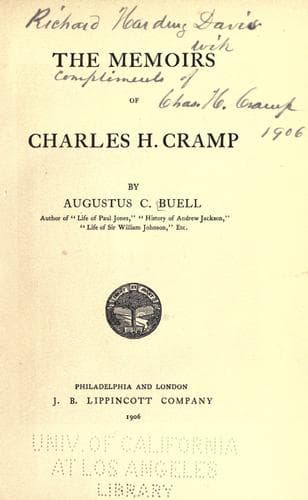
Cramp, Charles Henry, 1828-1913; Naval architects -- United States -- Biography
“In my judgment, it is hardly possible to overvalue the importance
of homogeneity in fleet organizations, and I am sure that the very
first and perhaps greatest lesson taught by an encounter between
fleets of modern battleships will be the advantage of similarity of
type and equality of performance in the units of action.
“To this element of the art of naval warfare, then, I would invite
your most earnest and penetrating attention and study.
“Assuming this problem to be satisfactorily solved and the material
of the fleet in the most effective possible condition, so far as
relation of units to each other and to the sum-total is concerned,
we have still left for consideration the difference between men, the
lack of uniformity in _personnel_. Homogeneity of material may be
attained by adherence to a wise programme of design and
construction; but homogeneity of _personnel_, in the sense of
uniform capacity and efficiency among individuals, is beyond human
art or science to produce, because the difference between men is the
decree of a higher power. The existence of this college is itself a
devout recognition of that great fact, because its whole objective
is to mitigate or minify as much as possible this inherent human
frailty, by exhausting the resources of training and study, of
precept and example.
“I do not by any means argue that the commander of a ship should be
a naval architect or constructor. But, having familiarized himself
with the principles of that art which touch directly and immediately
his function of handling his ship under sea conditions of common
occurrence, and having gained sufficient knowledge of her traits, he
should be able to form an instant and correct judgment as to her
point of best behavior in any sea-way. It goes without saying that
sea experience is the only school in which these problems can be
worked out.
“Knowledge of that character cannot be acquired by study of the
experience of others. Close and earnest attention to this course of,
at best partial, information cannot serve as a substitute for
experience of one’s own. At most it can only provide a sound basis
on which to take quick advantage of one’s own experience, when
confronted with an actual situation.
Public-domain text, read in full here on John Shaqi.
Reviews
Reviews
No reviews yet
Be the first to share your thoughts on this work.
Elsewhere in the archive
Join the Discussion
Join the discussion
Sign in to leave a comment or review.
Sign InorCreate an account