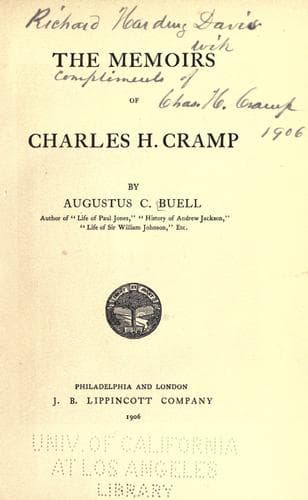
Cramp, Charles Henry, 1828-1913; Naval architects -- United States -- Biography
Armstrong’s—Russian War-ship Construction—Arrival of “Cimbria” at
Bar Harbor—Visit of Wharton Barker to Shipyard—Visit of
Captain Semetschkin and Commission to the Yard—Purchase of
Ships—Newspaper Accounts—Captain Gore-Jones—Mr. Cramp’s account of
Operations—“Europe,” “Asia,” “Africa,” and “Zabiaca”—Popoff and
“Livadia”—Visit to Grand Duke Constantine—Anniversary Banquet in St.
Petersburg of Survivors of “Cimbria” Expedition—Object of Visit to
Russia—Mr. Dunn and Japan—Contract for “Kasagi”—Jubilee Session of
Naval Architects in London—Visit to Russia—Correspondence with Russian
Officials—Visit to Armstrong’s—Japanese War-ship Construction—“Coming
Sea Power”—Correspondence with Russian Official—Invited to
Russia—Asked to bid for War-ships—Our Ministers abroad—Construction of
“Retvizan” and “Variag”—“Maine”
THE old Latin poet Horace introduces his First Book of “Sermons or
Satires” by addressing to his great patron, Mæcenas, the question:
“Qui fit, Mæcenas, ut nemo, quam sibi sortem
Seu ratio dederit, seu fors objecerit illa
Contentus vivat? laudet diversa sequentes?”
(“How is it, Mæcenas, that no one lives content with the lot that
endeavor has given to him or that fortune has thrown in his way? but
emulates those following other pursuits?”)
Mr. Cramp reached the condition described by Horace early in the last
decade of the nineteenth century. He had exhausted the opportunities of
American ship-building, both for war and for commerce. A fleet, not only
respectable in number but formidable in type and power,—a fleet
embracing battleships, armored cruisers, and protected cruisers,—bore
the impress of his art and heralded the distinction of his name. To this
compact war-fleet he had added two ocean greyhounds, the first of their
type built in the Western hemisphere. In prosecution of all this
advancement, if we take the decade from 1885 to 1895, he had multiplied
the area of the shipyard by two, and its capacity alike in number and
size of steamships and their machinery more than three. In 1889, some
people—and among them his own associates in the ownership of the
yard—were afraid to undertake the armored cruiser “New York.” Mr. Cramp
met this obstruction with radical action, as was his wont in every
emergency; and in four years from that time he had laid the keels of
Atlantic greyhounds whose register tonnage was more than two thousand
tons greater than the total displacement of the “New York.”
Public-domain text, read in full here on John Shaqi.
Reviews
Reviews
No reviews yet
Be the first to share your thoughts on this work.
Elsewhere in the archive
Join the Discussion
Join the discussion
Sign in to leave a comment or review.
Sign InorCreate an account