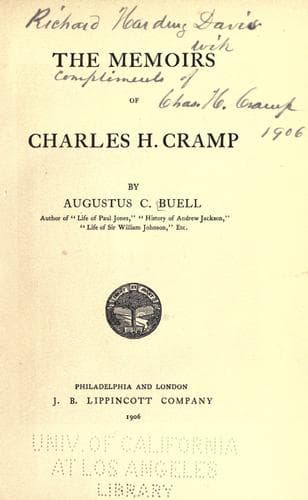
Cramp, Charles Henry, 1828-1913; Naval architects -- United States -- Biography
Mr. Cramp had long been emulous, some Englishman might say envious, of
the wonderful career of Sir William Armstrong and of his marvellous
success in securing foreign contracts. On one occasion, returning from a
visit to Elswick with a party from the British Institution of Naval
Architects, of which he is a member, Mr. Cramp remarked that “Armstrong
and his establishment had ceased to be ship-builders in the ordinary
acceptation of the term and had become navy-builders. They do not
trouble themselves,” he said, “with isolated ships; to all intents and
purposes they undertake to build whole navies in bulk for ambitious
maritime states in South America and Asia.” At the time of the visit
referred to, with exceptions hardly worth mention, the navies of Brazil,
Argentine Republic, Chile, Japan, and China had been built, engined,
armed, armored, munitioned, equipped, and outfitted at Elswick; and
every ship was ready for battle when she finally sailed from Armstrong’s
works. In addition to this, Elswick had done a great deal of work for
European states, having, at one time or another, contributed in some
degree to every European navy, great or small, except those of France
and Russia.
To a man of Mr. Cramp’s untiring aspiration and restless ambition, this
was a spectacle not to be supinely endured. He therefore determined to
see what could be done, and he selected what seemed to him the most
promising directions of effort,—Russia and Japan. In dealing with the
Russians he had initial advantages. The first was that Russia never had
a war-ship, except the nondescript “Livadia,” built in England, though
she had been a liberal patron of English engine-builders. The second
point of advantage was that in 1878-79 a considerable volume of work had
been done by Cramp for the Russian navy, involving conversion of three
large merchant steamships into auxiliary cruisers and the construction
of one small cruiser.
The history of this interesting event, an event of international
importance, is as follows:
In the early part of the year 1878 the North German Lloyd steamer
“Cimbria” appeared at Bar Harbor with about sixty Russian officers and
about eight hundred men. Their presence at that place created a great
sensation. Visitors thronged there; and the officers were entertained at
Bangor and also in the neighboring towns. The common sailors, however,
who were allowed to go ashore about one hundred and fifty at a time,
were cruelly disappointed. They would go along the streets searching for
vodka in vain. The Maine law, which was in full force, was something
beyond their comprehension. “There is everything in the world here but
vodka,” they would say to one another, and even to their officers, when
they returned to their ship from shore liberty.
Public-domain text, read in full here on John Shaqi.
Reviews
Reviews
No reviews yet
Be the first to share your thoughts on this work.
Elsewhere in the archive
Join the Discussion
Join the discussion
Sign in to leave a comment or review.
Sign InorCreate an account