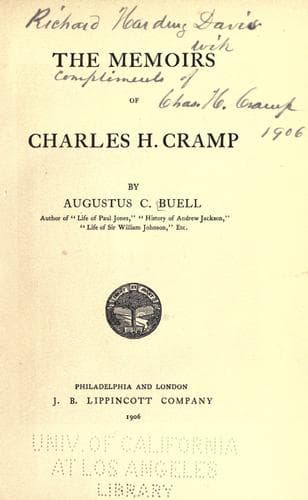
Cramp, Charles Henry, 1828-1913; Naval architects -- United States -- Biography
Almost at the same moment when the “Cimbria” arrived in the waters of
Maine, Mr. Wharton Barker visited Cramps’ shipyard. The banking concern
of Barker Brothers was at that time the representative of the Barings,
who were the financial agents of Russia. Mr. Barker informed Mr. Cramp
that he was delegated to arrange for the conversion and fitting out of a
number of auxiliary cruisers for the Russian navy, and that he had
selected the Cramp Company as the professional and mechanical
instrumentality for that purpose. He arranged for a visit of a number of
Russian officers to the office of the Cramp Company. These officers had
come over independent of the “Cimbria,” but arrived about the same time.
They were the Committee or Board which had been appointed to decide on
all questions that might arise in connection with the naval project
mentioned. The head of this Board was Captain Semetschkin, Chief of
Staff of the Grand Duke Constantine, who was then General Admiral of the
Navy. Besides Captain Semetschkin, the Board consisted of Captain
Grippenburg, Captain Avalan, Captain Alexeieff, Captain Loman, Captain
Rodionoff, and Naval Constructor Koutaneyoff. This was in 1879. At this
writing (1903) Captains Semetschkin and Loman have passed away; Captain
Avalan is now Vice-Admiral and Imperial Minister of Marine; Captain
Alexeieff, now Vice-Admiral, is also Viceroy of Manchuria; Captain
Rodionoff is an Admiral; and Naval Constructor Koutaneykoff is
Constructor-in-Chief of the Russian navy.
Upon examination of Cramps’ shipyard, they decided that Mr. Barker’s
selection was well judged, and approved his recommendations that the
work projected be done there.
The war between Russia and Turkey was still in progress, and there was
every indication at that moment of British intervention. The purpose of
the Russians was to fit out a small fleet of auxiliary cruisers or
commerce destroyers to cruise in the North Atlantic in the route of the
great British traffic between the United States and England. Their idea
was that the fitting out of such a fleet with its threatening attitude
toward their North Atlantic commerce might or would deter the British
from armed intervention in behalf of the Turks.
Public-domain text, read in full here on John Shaqi.
Reviews
Reviews
No reviews yet
Be the first to share your thoughts on this work.
Elsewhere in the archive
Join the Discussion
Join the discussion
Sign in to leave a comment or review.
Sign InorCreate an account