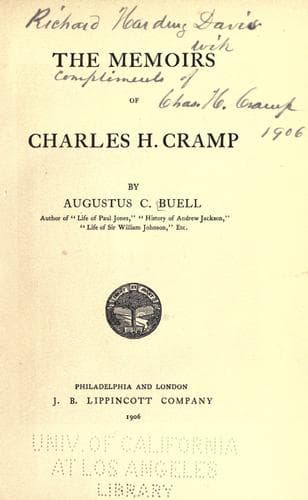
Cramp, Charles Henry, 1828-1913; Naval architects -- United States -- Biography
“The indications that the English would join the Sultan at any time
still prevailed at the time the vessels were ready to go to sea.
When the ‘Europe,’ ‘Asia,’ and ‘Africa’ were ready to depart, they
had to go without any guns, because all the loose guns that the
Russians could spare from the navy were mounted on forts, and none
could be appropriated for these ships, so they had to depart without
guns. They expected when they came here to be able to purchase guns
in this country from some of the gun manufacturers, and they were
very much amazed to find that our government had not permitted any
gun factories to exist here. So they had to go without.
“The captains all showed great determination and pluck, but their
going away was not under the conditions usually attending the
departure of war vessels. They expected when they left that England
would openly espouse the cause of Turkey before they arrived at the
other side, and they were all prepared to sink their ships rather
than surrender. They felt that their case was particularly hard and
that their hands were tied, and having no guns they were at the
mercy of the enemy. They could not find much satisfaction of sinking
with their own ships unless they had done some damage to the enemy,
so under the circumstances their sailing was a very sad occasion.
“The ‘Zabiaca’ being a new vessel, it took longer to finish her, and
by the time she was finished the war with Turkey was over, and they
managed to get guns to put aboard her.
“The fitting out of this small fleet of commerce destroyers had the
effect that the Russians originally intended it to have. It deterred
the English from going in with the Sultan. The merchant fleet of
England is too great and too vulnerable to permit their country to
go to war for a trifle. England would suffer more in a war than any
other nation on account of the large number of merchant-men under
her flag; and it was because of the great number of her ships and
the danger and loss from their destruction that made the British
government and its people labor so hard to have our navigation laws
repealed, so that a fictitious sale could be made and the vessels of
their merchant marine could be put under the protection of the
American flag. As two of our statesmen said (Henry C. Carey and
Judge Kelley), ‘As long as our navigation laws remain as they are,
England will be under perpetual bonds of indemnity to keep the peace
with all the small nations in the world, because their
merchant-ships cannot fly to the protection of the American flag.’
In this case the English saw the scheme of the ‘Alabama’ applied to
themselves.
“These vessels went abroad, and most of them became flag-ships on
foreign stations.
Public-domain text, read in full here on John Shaqi.
Reviews
Reviews
No reviews yet
Be the first to share your thoughts on this work.
Elsewhere in the archive
Join the Discussion
Join the discussion
Sign in to leave a comment or review.
Sign InorCreate an account