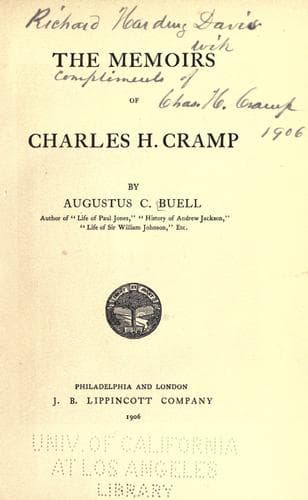
Cramp, Charles Henry, 1828-1913; Naval architects -- United States -- Biography
“Finally, he considered all preliminary difficulties overcome, and
began a siege of Cramps’ shipyard by regular approaches. Finding it
impregnable to front attack, he resolved to flank it. This he
accomplished by taking possession of an adjoining lumber yard in the
night-time. Early in the morning he entered the fortress by its
sally-port. Success was in his grasp,—almost. It glittered, then it
glimmered, then it fizzled out. There was one peculiarity he
couldn’t overcome. That was his remarkable resemblance in form and
figure to ‘Punch’s’ standard cartoon of ‘John Bull.’ He could smoke
a short, black pipe with the bowl turned down equal to the most
Corkonian Irishman in Fishtown. He could also fairly imitate that
peculiar accent produced by filtering conversation through the
teeth, commonly known as the brogue, particularly when the
conversation was diluted with a mouthful of Irish whiskey. But he
couldn’t escape his shape. One of the Russian officers on duty at
Cramps’, with that keenness characteristic of Napoleon’s ‘scratched
Tartar,’ penetrated all his disguises. Then he was ignominiously
ejected by one of those decrepit men who, when they get too old to
build ships, are usually employed by Cramps’ as watchmen. _Sic
transit gloria mundi._ Exit Gore-Jones. But he will remain with us.
He will hold his job. He deserves to. He has done what no American
has ever been able to do since the collapse of the Rebellion. He has
discovered a navy—an actual, real, live navy—in the United States.
The fact that it is a Russian navy and not an American one,
humiliating as it may be to us, is a huge feather in the cap to him.
We hasten to doff our editorial chapeau to Gore-Jones. We are
confident he will get his star. We fervently hope he may get also
the garter.”
At this point Mr. Cramp’s own narrative of the subsequent proceedings
will be more graphic and interesting than any other form of description
could be:
“Great activity marked the progress of alterations and fitting out
of the vessels. The yard was filled with men, some working night and
day, and the vessels were all fitted out at a very early date,
considering what had to be done. They were more than rebuilt. Each
ship was fitted out for an admiral and the accommodations for
officers and men were ample. They were full sparred and
square-rigged.
Public-domain text, read in full here on John Shaqi.
Reviews
Reviews
No reviews yet
Be the first to share your thoughts on this work.
Elsewhere in the archive
Join the Discussion
Join the discussion
Sign in to leave a comment or review.
Sign InorCreate an account