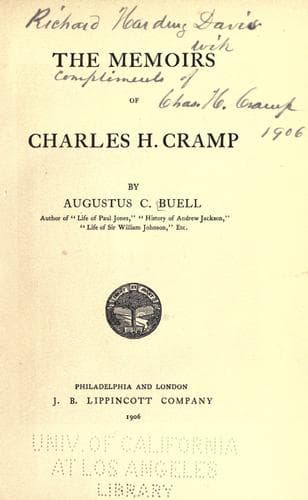
Cramp, Charles Henry, 1828-1913; Naval architects -- United States -- Biography
There was, however, one difficulty in the way of Japanese patronage of
American shipyards in the construction of naval vessels. This difficulty
soon came to the surface, but was averted by the urgency of diplomatic
considerations. It grew out of the fact that the money which Japan was
using to augment her navy was that which she realized from the Chinese
Indemnity paid under the provisions of the Treaty of Shimonoseki. This
indemnity had been furnished by Russia and financed in England or by
English capitalists; and it appeared that there was a sort of tacit, if
not express, understanding that most of it was to be spent in naval
construction, and that the ships which it was to pay for should be built
in English shipyards. However, the Japanese naval authorities were
extremely desirous of adding one or more American-built ships to their
fleet; their idea, from the professional point of view, being that, as
they were then about prepared, or had been for some time engaged in
preparing, to build ships at home in their own dock-yards, the
possession of one or more American-built ships would be of value as
samples, models, or object lessons. Finally, after considerable
negotiation carried on partly with or through the Japanese Minister at
Washington, and partly at head-quarters in Tokio, the Japanese
government awarded a contract to Cramp for the construction of a
first-class protected cruiser of the highest attainable speed. This
contract was signed by Mr. Cramp on behalf of the Company and by Toru
Hoshi, the Minister, on behalf of his Majesty, the Emperor of Japan. The
vessel, the “Kasagi,” was originally designed to be of about 5000 tons
displacement, but was modified to a displacement of about 5500 tons. The
guaranty was 17,000 indicated horse-power and twenty-two and one-half
(22½) knots speed, to be determined by four runs, two each way over a
measured course ten knots long. Upon her completion the ship was taken
in charge by the Japanese captain and crew, and upon her arrival home
immediately took a conspicuous place in the Japanese navy. Although this
vessel gave the most profound satisfaction in every respect, and
although she had been built in the United States at a cost that compared
quite favorably with relative contract prices elsewhere, the Japanese
did not repeat the experiment for reasons already intimated. In fact,
all the influence of British diplomacy upon the policy of Japan was
successfully employed in securing the maintenance of the British
alliance in opposition to the advance of the Russians in the direction
of the Pacific and to retain the monopoly that English ship-builders,
principally Armstrong, had previously enjoyed, and to prevent or
prohibit the construction of any more vessels of war in the United
States or in American shipyards.
Public-domain text, read in full here on John Shaqi.
Reviews
Reviews
No reviews yet
Be the first to share your thoughts on this work.
Elsewhere in the archive
Join the Discussion
Join the discussion
Sign in to leave a comment or review.
Sign InorCreate an account