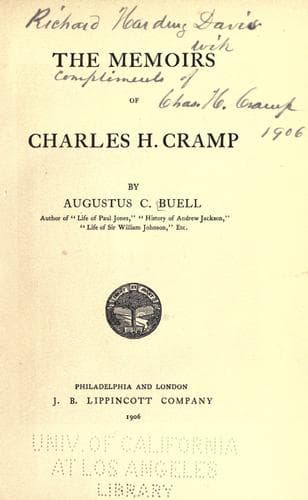
Cramp, Charles Henry, 1828-1913; Naval architects -- United States -- Biography
At this point it becomes necessary to take up a new branch of the
general subject, which is that of foreign work.
[Illustration: MEDI-J-IEH LAUNCHING—TURKISH
Copyright, 1904, by John W. Dawson]
While the correspondence with the authorities of the Russian government
above referred to was going on, our Minister at Tokio, Mr. Dunn, called
the attention of the Japanese government to the fact that their
expenditure of vast sums of money on a new navy in England principally,
and also in France and Germany on a smaller scale, was well known; and
in a diplomatic way he suggested that some of that kind of patronage
bestowed upon the ship-building interests in the United States would be
extremely gratifying to the American people. He also thought that the
popularity of such a project in this country would be made universal if
part of the proposed patronage should be awarded to the Atlantic and
part to the Pacific coast. Minister Dunn’s suggestion was taken up by
the American Trading Company in the Orient, and their joint advocacy of
the scheme was crowned with success. Acting upon intimation of such a
suggestion, the Cramp Company and the Union Iron Works of San Francisco
sent agents to Japan, and when they returned, contracts were made with
the Japanese Minister Toru Hoshi, representing the Imperial Government,
and the two ship-building companies above mentioned. The ship built by
Cramp is now known in the Japanese navy list as the “Kasagi,” and that
built by the Union Iron Works of San Francisco as the “Chitose.”
Up to that time the Japanese navy had been built almost exclusively in
England, and with unimportant exceptions wholly by Armstrong. Of the
vessels which won the naval battles on the Yellow Sea in the
Chino-Japanese War of 1894 almost all, with the exception of a few
torpedo craft, were built by Armstrong & Company at Elswick.
Public-domain text, read in full here on John Shaqi.
Reviews
Reviews
No reviews yet
Be the first to share your thoughts on this work.
Elsewhere in the archive
Join the Discussion
Join the discussion
Sign in to leave a comment or review.
Sign InorCreate an account