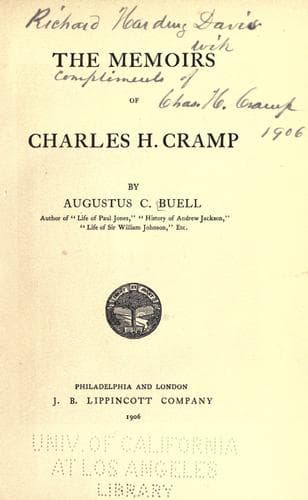
Cramp, Charles Henry, 1828-1913; Naval architects -- United States -- Biography
“I thought that the construction of such an advanced type of war
vessel under the conditions was of sufficient importance to inform
Lieutenant Colwell, our Naval Attaché at the United States Embassy.
When I called on him, he seemed surprised to find that I had made
the ‘discovery;’ and he stated that he had wired a cipher despatch
to Washington describing the ships, and that they were for the
Japanese, and that he had been informed of it by the Chinese Naval
Attaché, who was a very bright man and whose knowledge of the fact
was from an absolutely correct source. Mr. Colwell stated that no
one but the Chinese Attaché and himself was aware of it outside of
the Armstrong’s and the British government. Of course, the last
persons to be suspected of knowing anything about the matter were
the Japanese. Mr. Colwell was well posted as to the object of the
great enterprise.
“It was easy for Armstrong’s to keep a matter of this kind quiet, as
they had built so many war vessels for various countries, and with
eighteen on the stocks they would not be noticed; and, besides, they
were never without one or two vessels under construction for sale.
“The character of the vessels and the information that I gathered
from Mr. Colwell and the Chinese Attaché, and the fact that London
was filled with foreign naval officers, diplomats, and others in
attendance on the festivities, gave me opportunities to secure much
important information as to what was going on behind the scenes. The
Japanese in numbers and importance exceeded the delegates of the
other nationalities that participated in the Naval Architects’
ceremonies, and they were treated in the most obsequious and
deferential manner by all of the British dignitaries, ship-builders,
ordnance and armor makers, dealers in supplies, and the English
people generally.
“Soon after the Armstrong visit I met a Japanese nobleman, Marquis
Ito, or Iendo, at the Lord Mayor’s reception. He was the head and
front of the Japanese contingent, judging from the amount of
adulation that prominent British dignitaries and ship-builders
accorded him. Desiring to be sure of the facts in relation to the
Japanese ships at the Armstrong Works I accosted him with an air of
knowing all about it and as if there was no use of his denying
it,—hurrying along with my description in elaborate detail, giving
him no opportunity to reply,—I said: ‘Oh, Marquis Ito! I have just
examined your very fine ships at the Armstrong Works. They are
superior to anything in any navy, British or any other, and with the
speed of twenty knots and 7-inch armor and excellent model, etc.;’
running along without giving him time to reply until I got out of
breath and stopped.
Public-domain text, read in full here on John Shaqi.
Reviews
Reviews
No reviews yet
Be the first to share your thoughts on this work.
Elsewhere in the archive
Join the Discussion
Join the discussion
Sign in to leave a comment or review.
Sign InorCreate an account