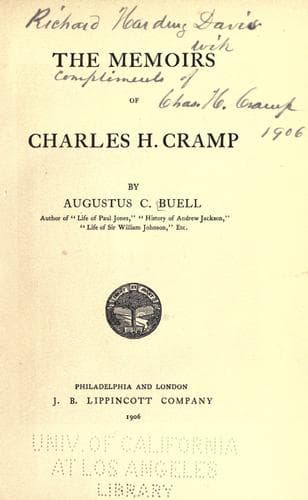
Cramp, Charles Henry, 1828-1913; Naval architects -- United States -- Biography
“During my talk his face was a study. It was impossible to note or
guess at his impressions, and I was extremely doubtful as to the
result; but the fact that we were then building a Japanese war
vessel, the ‘Kasagi,’ led him to believe that I knew something,
particularly as my elaborate description in detail of the qualities
of the ships under construction was correct; so, being sure that I
was thoroughly posted, he made no denial, but bowed smilingly and
with an air of approval. I had no opportunity of discussing the new
fleet with Mr. Tchernigovsky after we left the Armstrong Works, but
from information I subsequently received I was satisfied that his
early visit to Newcastle was not accidental.
“The discovery of the construction of this fleet was the origin of
my article on ‘The Coming Sea Power’ in the _North American Review_
of October, 1897.
“I ascertained while in London, from additional sources not to be
mentioned here, that the construction of these ships was undertaken
in consequence of a secret alliance between Great Britain and Japan
to prevent the United States from securing possession of the
Sandwich Islands and to head off the Russians in the Pacific, etc.
“The great engineering strike in Great Britain during this time
delayed the delivery of the Japanese vessels and the construction of
the great fleet of British ships then under way for two or three
years, and the whole thing fell through because the favorable
opportunity had passed. The delay gave them time to think it over.
And, besides, we were beginning to make a show of naval power. It
was also at this time that the Germans were beginning to show their
practical aspirations in the direction of ‘sea power.’
“The construction of the ships and their object was known also to
Captain Gregorovitch, Russian Naval Attaché in London, and that
probably accounted for the visit of Mr. Tchernigovsky.
“One interesting circumstance in connection with this strike and its
consequences was the fact that under the operations of the strike a
very large number of the best English shipyard workmen and engineers
went to Germany, and became permanently located there in the
shipyards; and while their absence crippled Great Britain, they more
than any other cause advanced the construction of the German navy;
so that while the leaders of the strike in England gained nothing by
it there for the engineers but disaster to themselves and their
country, they were conspicuously instrumental in assisting the most
powerful rival of England.
“It would be an interesting subject for reflection or discussion as
to what might have been the consequences if the strike had not
occurred and the Japanese and British fleets had been finished two
years before they were.
Public-domain text, read in full here on John Shaqi.
Reviews
Reviews
No reviews yet
Be the first to share your thoughts on this work.
Elsewhere in the archive
Join the Discussion
Join the discussion
Sign in to leave a comment or review.
Sign InorCreate an account