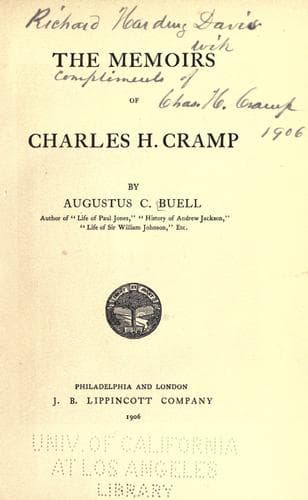
Cramp, Charles Henry, 1828-1913; Naval architects -- United States -- Biography
“Most well-informed people have a pretty clear general idea that the
present is an era of unexampled naval activity throughout the
civilized world; that great fleets are building everywhere; that the
ships composing them are of new types, representing the highest
development of naval architecture and the most exquisite refinement
of the art of naval armament. Doubtless, a much smaller number of
persons are aware that a new factor of imposing proportions has come
into the general situation; that the newest member of the family of
civilization is with rapid strides reaching a status of actual and
potential sea power with which the older nations must henceforth
reckon most seriously.
“It is, however, questionable whether any one not intimately
conversant with the current history of modern ship-building, or not
qualified to estimate properly the relative values of actual
armaments, can adequately conceive the vast significance of the
prodigious efforts which this youngest of civilized nations was
then, and still is, successfully putting forth toward the quick and
sure attainment of commanding power on the sea.
“In order to estimate accurately the significance of the current
naval activity of Japan, it is requisite to trace briefly her prior
development as a maritime power.
“The foundation of the Japanese navy was laid by the purchase of the
Confederate ram ‘Stonewall,’ built in France in 1864, surrendered to
the United States in 1865, and shortly afterward sold or given to
Japan. This ship was soon followed by another of somewhat similar
type, built at the Thames Iron Works in 1864-65, now borne on the
Japanese navy list as the ‘Riojo,’ and used as a gunnery and
training ship.
“From that time to the period of the Chinese War the naval growth of
Japan was steady, and, considering her very recent adoption of
Western methods, rapid.
“At the beginning of that war, Japan, though possessing a very
respectable force of cruisers and gunboats, mostly of modern types
and advanced design, had no armored ships worthy of the name. The
old ‘Stonewall’ had been broken up, the ‘Fu-So,’ the ‘Riojo,’ the
‘Heiyei,’ and the ‘Kon-Go,’ built from 1865 to 1877, were obsolete,
and the ‘Chiyoda,’ the only one of modern design and armament, was a
small armored cruiser of 2450 tons, with a 4½-inch belt, and no guns
larger than 4.7-inch caliber.
Public-domain text, read in full here on John Shaqi.
Reviews
Reviews
No reviews yet
Be the first to share your thoughts on this work.
Elsewhere in the archive
Join the Discussion
Join the discussion
Sign in to leave a comment or review.
Sign InorCreate an account