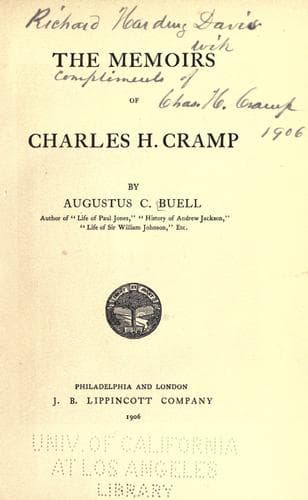
Cramp, Charles Henry, 1828-1913; Naval architects -- United States -- Biography
Two first-class armored cruisers, 9,750 20 (Japan.)
contracted for Besides mercantile
vessels at their shipyard at
Walker.
By the end of the year 1897, or rather during this year, besides the
ships enumerated above for Japan there were in course of construction
elsewhere:
One battleship (“Fuji”), in commission.
One battleship, 14,800 tons, building at Thames Iron Works.
One battleship, 14,800 tons, building at Thompson’s.
One battleship, 10,000 tons, under consideration, the Armstrong Works
(contract not signed).
One armored cruiser, 9600 tons, ordered at Vulcan Works.
One armored cruiser, 9600 tons, ordered at St. Nazaire.
Four torpedo-boat destroyers of 30 knots, similar to British destroyers
of 30 knots, building at Yarrow.
Four torpedo-boat destroyers of 30 knots, similar to British destroyers
of 30 knots, building at Thornycroft.
One torpedo-boat destroyer of 30 knots (?), similar to British
destroyers of 30 knots, building at Schichau.
Eight torpedo boats of 90 tons, Schichau.
Four torpedo boats of 90 tons, Normand.
The Japanese battleships are named “Yashima,” “Hatzure,” “Mikasa,”
“Asahi,” and “Shikisima.”
[Illustration: MEDI-J-IEH IN COMMISSION
Copyright, 1904, by John W. Dawson]
The first-class armored cruisers with seven-inch side armor at
Armstrong’s were the “Asama,” “Idzumo,” “Iwate,” and “Takima;” at St.
Nazaire, France, “Azuma;” and at the Vulcan Iron Works, Stettin,
Germany, the “Yakumo.” Five battleships, 6 armored cruisers, and 21
torpedo boats under construction in 1897, in addition to the ships in
their own yards.
Soon after his return to America, Mr. Cramp decided that the results of
his visits to the Armstrong Works should be given to the public, as
there were no obligations of secrecy imposed on him, and particularly as
he thought that the United States was, or should be, interested in the
matter; besides, he desired to extend the field of the operations of
their ship-building works abroad and secure a small portion of the
construction of war-ships which England, France, and Germany had
monopolized, and for that purpose he prepared a paper, which was printed
in the November number of the _North American Review_ for 1897. This
paper added a considerable scope of discussion applying directly to the
relative naval activity of Russia and Japan, and drawing, or rather
pointedly leaving for inference, the conclusion that Russia was not
keeping pace with the development of her already great and rapidly
growing rival in the Oriental Pacific.
This paper was as follows:
“THE COMING SEA POWER.”
Public-domain text, read in full here on John Shaqi.
Reviews
Reviews
No reviews yet
Be the first to share your thoughts on this work.
Elsewhere in the archive
Join the Discussion
Join the discussion
Sign in to leave a comment or review.
Sign InorCreate an account