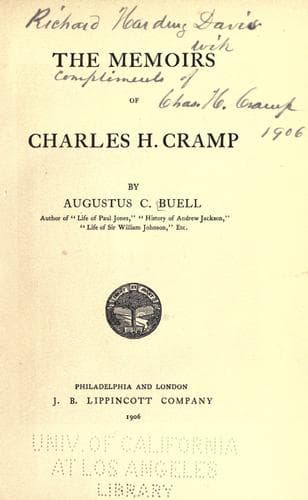
Cramp, Charles Henry, 1828-1913; Naval architects -- United States -- Biography
In this paper, it need hardly be said, Mr. Cramp hewed to the line. He
did not flatter the Russians nor did he omit to advise them of the full
extent and unquestionable consequences of their procrastination and
supineness. When the paper was prepared and had been finally revised,
Mr. Cramp still hesitated about publishing it in that form. “The
Russians,” he said, “are extremely sensitive; they know their weakness,
or the best minds among them know it quite as well as I have pointed it
out in this paper. Of course, I intend it as an appeal to their
patriotism and to their sense of their country’s needs; but I am afraid
that it will hurt the sensibilities of some of them.” However, after
further consideration, Mr. Cramp determined to print the paper as it
stood, and it was done. Probably no article appearing in an American
magazine in many years, if ever, received as widespread or as earnest
attention in Europe as did Mr. Cramp’s paper on “The Coming Sea Power.”
As soon as the _North American Review_ arrived in Europe, the paper was
translated and printed in Russian and German and a copious synopsis of
it in French, in the naval periodicals of the respective countries. It
was also extensively discussed and criticised in the English press, both
in the service papers and in the regular daily journals. In St.
Petersburg, besides being translated and printed in the principal
Russian magazine and discussed in the newspapers, it was made the basis
of an address by one of the most eminent Admirals in the Russian navy.
Mr. Cramp’s cautious apprehension, already referred to, that it might
touch the susceptibilities of Russian officers proved groundless; and it
has been openly admitted by high officials of the Russian Ministry of
Marine that the arguments and considerations so vigorously advanced by
Mr. Cramp had an effect of no little potency in turning the scale of
Russian policy, which a few months later found expression in the great
naval programme of 1898.
Early in the following spring Mr. Cramp received advices from St.
Petersburg that the Ministry of Marine would be glad to entertain plans
and proposals from him for the construction of at least two first-class
battleships, two first-class protected cruisers of the highest speed,
and thirty torpedo boats, under the new programme which had then,
February, 1898, been finally authorized by the Ministry and approved by
the Emperor Nicholas II.
Public-domain text, read in full here on John Shaqi.
Reviews
Reviews
No reviews yet
Be the first to share your thoughts on this work.
Elsewhere in the archive
Join the Discussion
Join the discussion
Sign in to leave a comment or review.
Sign InorCreate an account