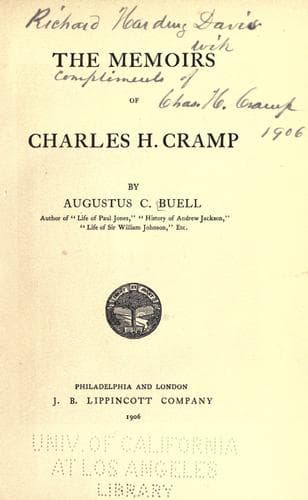
Cramp, Charles Henry, 1828-1913; Naval architects -- United States -- Biography
Upon receipt of this information or suggestion, Mr. Cramp lost no time
in preparing for the voyage. Although the time of year, early in March,
was the most inclement season for a visit to the great northern capital,
he cheerfully accepted the situation. So far as the general scheme and
outline plans were concerned, he had substantially worked them out in
anticipation, and not much delay was caused on that account. Early in
March, 1898, Mr. Cramp sailed on the American Line steamship “St. Paul,”
bound for St. Petersburg by the way of Southampton. Upon his arrival at
the Russian capital, he was immediately turned over to the tender
mercies of what is known as the Technical Board. This in Russian naval
administration is a Board composed of officers representing all the
branches of the service,—Line, Construction, Engineering and Ordnance,
or the Artillery Branch, as they call it. The membership of this Board
is considerable in number. For several weeks they subjected Mr. Cramp to
a species of inquisition which might well have appalled a man of less
resources, less determination, or less confidence in his own ultimate
mastery of the situation. It is not worth while, even did our limits of
space admit, to go into detail of Mr. Cramp’s discussion of his proposed
designs and plans with the members of the Technical Board. Suffice to
say, that after some weeks of consideration, taking the widest possible
range, a general agreement was reached, leaving but few questions open
for subsequent determination, none of which were of vital importance.
The sequel of the whole transaction was that on the 23d of April, 1898,
contracts were signed by Mr. Cramp on behalf of the Company, and by
Vice-Admiral V. Verhovskoy, Chief of the Department of Construction and
Supply, on behalf of the Emperor, for the construction of two vessels,
one first-class battleship, now known as the “Retvizan,” and one
first-class protected cruiser of the highest practicable speed, known as
the “Variag.”
Public-domain text, read in full here on John Shaqi.
Reviews
Reviews
No reviews yet
Be the first to share your thoughts on this work.
Elsewhere in the archive
Join the Discussion
Join the discussion
Sign in to leave a comment or review.
Sign InorCreate an account