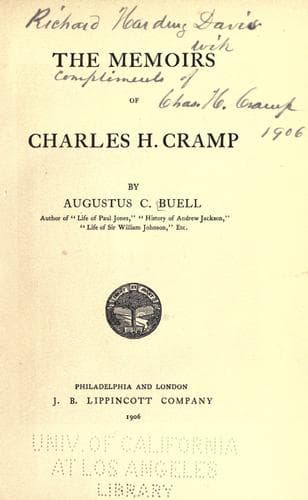
Cramp, Charles Henry, 1828-1913; Naval architects -- United States -- Biography
The fact is, that whenever Mr. Cramp undertook to write or dictate for
publication upon professional topics, he was almost instinctively
controversial, almost intuitively combative. His long experience and his
drastic training enabled him to see through any device within his
professional sphere as through a pane of glass, and he could read its
shortcomings or its defects as an open book. In such premises, it was
never his wont to be sparing. But his criticisms were so uniformly
sound, his comments so logical and practical, and his motives so
palpably beyond question, that he was seldom combated at all, and never
successfully.
In the foregoing chapters we have reproduced extracts from his published
papers and correspondence upon purely professional subjects. As the
reader has perceived, they involve not only knowledge of everything
within the immediate sphere of his own vocation, but also a broad and
generous group of the problems of international politics and diplomacy.
Mr. Cramp was not merely an adept in the design and construction of
ships, he was equally versed in that more subtle array of physical and
moral forces which in our day have come to be grouped under the general
head of “Sea power;” and his conception of the ultimate international
objects to be subserved and wrought out by the ships he built was as
clear as his knowledge of the details of their building.
In the domain of general thought, of history, and of ethics, Mr. Cramp
was only a little less prolific than in the literature of his own
profession. His address to the Netherlands Society on the Anglo-Dutch
Wars of the seventeenth century, delivered at the Union League, January
24, 1898; his “Forecast of the Steel Situation,” published January 18,
1900, which events two years later converted into prophecy, and a recent
article written for the journal of the Central High School (_The
Mirror_) on the subject of Fakes and Pretenders, introducing as his text
the notorious Keely and his “motor,” with many others like them, must be
passed over with simple mention. Reproduction of them even by extract or
in synopsis could only reinforce the impression, already clear, of the
wide diversity of his thought, the vast scope of his observation, the
keen thoroughness of his research, and the wonderful assimilative
capacity of his mind.
------------------------------------------------------------------------
● Transcriber’s note:
○ Missing or obscured punctuation was corrected.
○ The Table of Contents was reformatted to save space.
○ Typographical errors were silently corrected.
○ Inconsistent spelling and hyphenation were made consistent only
when a predominant form was found in this book.
Public-domain text, read in full here on John Shaqi.
Reviews
Reviews
No reviews yet
Be the first to share your thoughts on this work.
Elsewhere in the archive
Join the Discussion
Join the discussion
Sign in to leave a comment or review.
Sign InorCreate an account