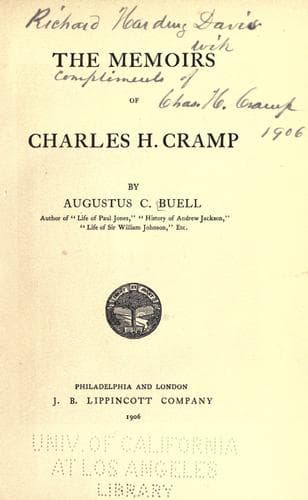
Cramp, Charles Henry, 1828-1913; Naval architects -- United States -- Biography
Immersed though he always was in affairs of the most practical and
matter-of-fact nature, Mr. Cramp could always find time for the society
of the clever Bohemians of literature, art, and the drama. No other
association was so congenial to him. No other business man of his time
numbered so many friends and close acquaintances in that fraternity as
he. In him they always found quick appreciation of their abilities and,
when occasion might require, ready and cordial responsiveness to their
incidents of vicissitude. During the scores of years through which he
figured in a capacity as public and in affairs as momentous as ever fell
to the lot of the highest official, constantly engaged in operations
closely affecting the vitality and integrity of the nation, incessantly
subject to a scrutiny hardly less searching than “the fierce light which
beats upon a throne,” the files of American print for a lifetime may be
searched in vain for an ill-natured personal criticism upon his acts or
achievements or an aspersion upon his character. Even partisans of his
rivals, no matter what might be the bitterness of contention or the
rancor of faction, always halted at personal animadversion upon him.
This was not because he himself was reticent in criticism or always
cautious in comment. Having always ready and welcome access to the
columns of the most noted periodicals and the greatest newspapers, and
being by no means stingy of rhetoric, his innumerable newspaper
interviews and frequent magazine papers invariably “spoke his mind” with
neither extenuation nor malice, and always hewed to the line.
On one occasion he submitted a professional paper in manuscript to a
friend of literary pursuits whose judgment he held in high esteem. “In
that paper,” he said, “I have done my best to avoid all controversial
tendency. Please look it over and give me your view as to whether or not
I have succeeded.”
It was a paper on the subject of water-tube boilers involving discussion
of the various types, and referring to the policies of different naval
administrations at home and abroad in dealing with them.
“Well,” he inquired, when his friend returned the paper, “what do you
think of it?”
“I understood you to say, Mr. Cramp, that you desire to avoid
controversial matter in this paper?”
“Yes.”
“And you would strike out anything that might partake of that nature?”
“Yes.”
“Well, in that case, there would be little left but the title of the
paper!”
Public-domain text, read in full here on John Shaqi.
Reviews
Reviews
No reviews yet
Be the first to share your thoughts on this work.
Elsewhere in the archive
Join the Discussion
Join the discussion
Sign in to leave a comment or review.
Sign InorCreate an account