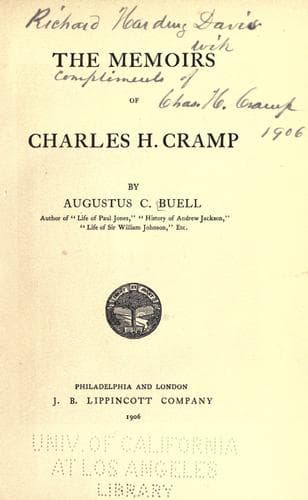
Cramp, Charles Henry, 1828-1913; Naval architects -- United States -- Biography
The generation of naval architects and ship-builders among whom he began
his life-work sixty years ago have long since passed away. Of them all
he stands alone, the only surviving link that binds the romantic
memories of wood and canvas to the grim realities of steel and steam.
Even the generation that knew him in the middle of his long and fruitful
career is gone. He is the only man who has alike designed and built
ships for the navy of the Civil War and for that of to-day,—alike for
the navy that fought at Charleston and Fort Fisher and for the navy that
won Santiago and Manila Bay,—twoscore years asunder! In all the history
of our country there has never been another professional career like
his. No other man ever made such an impress as he upon the life,
welfare, and progress of the nation. No other man, without ever holding
a public office, has so indelibly left his mark upon our greatest and
most vital public interests as he has done.
He has passed from the sphere of membership in his profession and has
become its exponent. His name is a synonym for the art in which he has
so long been master, and the mention of his personality instantly
suggests the science whose triumphs he has so often and so well won.
This status and this rank are by no means limited to our own country.
Mr. Cramp is as familiar in London as in Philadelphia; as well known in
Tokio and St. Petersburg as in New York or Washington.
Undoubtedly, the first impression one will derive from the study of Mr.
Cramp’s career and character as mirrored in his acts and his writings is
his singleness of purpose, fixity of resolve, and directness of method.
These are, in fact, his distinctive traits, and to them, throughout his
long and arduous life, all others have been rigorously subordinated. If
he appears to be exacting of others, he is yet more so with himself. It
is not to be expected that in a life so long, in an experience covering
literally the scope of the civilized world, and in a range of endeavor
so wide and diversified, all could be plain sailing. On the other hand,
few men have encountered more or greater obstacles. No man ever faced
them more cheerfully or combated them with more sanguine pluck. If he
did not always triumph over them, it was because they were
insurmountable, or because those upon whom he relied for a proper share
in the sum-total of effort failed him. He himself never left undone
anything that a clear head could devise or a resolute will strive for.
Public-domain text, read in full here on John Shaqi.
Reviews
Reviews
No reviews yet
Be the first to share your thoughts on this work.
Join the Discussion
Join the discussion
Sign in to leave a comment or review.
Sign InorCreate an account