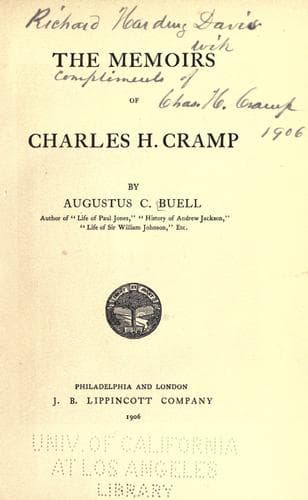
Cramp, Charles Henry, 1828-1913; Naval architects -- United States -- Biography
“In fact, it was this craze for the walking-beam engine and
side-wheels in New York which ruined us as a steamship building
country, and was one of the many causes for the supremacy in ocean
commerce that Great Britain ultimately attained.
“After the government had stopped the subsidy, the Collins Line,
which was run at an enormous expense, was withdrawn. We were
completely out of the business. The influence of Philadelphia, as we
had no large ships or large steamship companies, was not listened
to.
“Rather than adopt the propeller and go to Philadelphia to have the
engines built, steamship owners in New York permitted the whole
steamship business, together with all the foreign trade, to go to
foreign countries. The British began early to establish large
machine shops and to perfect the propeller engine. Though slow, they
were sure.
“There was not a time in the history of steam navigation that we did
not feel that we could equal or even excel the English builders of
propeller steamships that were coming to this country. But, as I
said before, we could not induce the New York merchants to embark in
the enterprise.
“I am sure that if we had abandoned the side-wheel and commenced
with the propeller at the time the British did and continued with
steadfastness, we never would have lost it.
“The ships of this country were right, of the best form and model,
and they were in advance of anything in Great Britain, as far as
hull construction and design were concerned; but, while the
ship-builders in New York were among the greatest in the world, the
builders of marine engines there were the poorest in the world.
“When it was discovered that the propeller steamship was in every
respect the best and had come to stay, it was too late to try to
recover our trade.
“The construction of monitors and machinery during the latter end of
the war was very demoralizing, and had its effect upon naval
constructions long after the war was over.
“The Construction Department, which had not shown much enterprise
during the war, had become very much deteriorated, and the system
was inaugurated, principally by Mr. Isherwood, which exists at the
present day, of dividing the executive department into many bureaus;
and, to strengthen their heads and give them power, it was also
provided that the appointment of these heads of bureaus should be
made by the President and confirmed by the Senate, thus making the
Senate a coördinate factor in their existence, and the heads of
bureaus independent of the Secretary of the Navy.
Public-domain text, read in full here on John Shaqi.
Reviews
Reviews
No reviews yet
Be the first to share your thoughts on this work.
Join the Discussion
Join the discussion
Sign in to leave a comment or review.
Sign InorCreate an account