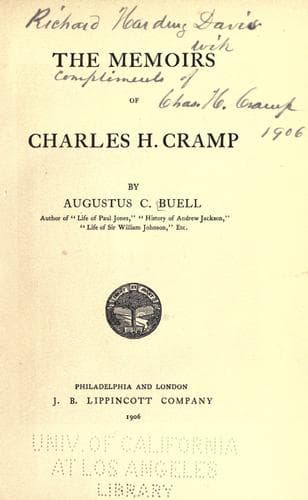
Cramp, Charles Henry, 1828-1913; Naval architects -- United States -- Biography
“This was started, as I said before, by Mr. Isherwood, who was on
Mr. Lenthall’s staff. He organized the Bureau of Steam Engineering
as an independent bureau, not subordinate to the Secretary, and
having its head appointed by the President and confirmed by the
Senate. Of course he was made its Engineer-in-Chief.”
That being started, other bureaus as they practically exist at present,
the heads of which are independent of the Secretary, were established
the same way. A great deal of friction occurred between the various
branches of the Navy Department at that time, the effects of which
continued for a good while. Nothing was built by the government,
although the Secretary of the Navy had full power to do practically as
he pleased with the appropriations. The appropriations in Congress at
that time were made in bulk, and the Secretary could give vessels out by
private contract or build them in the navy-yards.
Some few vessels involving antique ideas were started in the navy-yards
and were principally of wood. The engines were contracted for by the
various engine-builders of the United States. They were constructed
practically on one general design.
On account of some irregularities and misunderstandings in the way of
giving out contracts and certain favoritisms, together with the
jealousies and bickerings of the various heads of the Departments and
officers of the Navy, Congress became more and more exacting in their
appropriations, until at last nothing was done in the Navy Department
without a special appropriation for the particular purpose.
At the end of the Civil War in 1865, a large number of United States
vessels under contract were uncompleted. In some cases, notably of the
monitor type, work was immediately suspended upon them, and settlements
were made after long and tedious delays. The Cramp concern, as already
mentioned, had one vessel in hand under these conditions, the
first-class fast cruiser “Chattanooga;” but the government provided for
her completion, which was carried out, and her delivery concluded the
relations of Mr. Cramp to the navy of the Civil War.
[Illustration: CRUISER COLUMBIA]
------------------------------------------------------------------------
CHAPTER III
Public-domain text, read in full here on John Shaqi.
Reviews
Reviews
No reviews yet
Be the first to share your thoughts on this work.
Join the Discussion
Join the discussion
Sign in to leave a comment or review.
Sign InorCreate an account