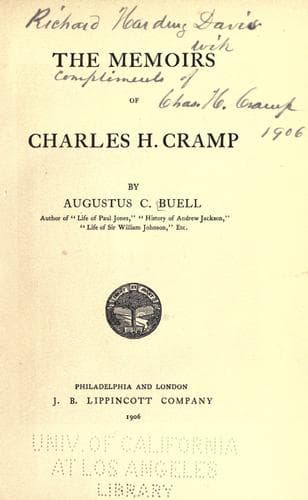
Cramp, Charles Henry, 1828-1913; Naval architects -- United States -- Biography
“When the organization of the Company was perfected, the compound
engine as developed by John Elder had made its appearance, and a
fierce opposition to its introduction was made by engine-builders in
Great Britain generally.
“Its advocates were among the ablest engineers in that country,
foremost among whom was Mr. MacFarland Gray, whose unassailable
attitude in its favor in the columns of ‘Engineering’ vindicated its
claims and successfully established its introduction. While the idea
was an old one and had been introduced before Watt’s time, it
failed, as most improvements do when they do not get into proper
hands to be developed.
“To John Elder belongs the credit of its permanent and practical
introduction into ocean navigation, and but little improvement has
been made in his work up to this time.
“Mr. B. H. Bartol, who occupied a high position for intelligence and
sagacity in the business world and as a practical marine engineer of
the highest attainments, was one of the directors of the new
steamship company, and, desiring that the ships should be in advance
of the times, he recommended that I should go to Great Britain and
make an exhaustive examination of the compound-engine question.
“Mr. J. Shields Wilson, who had been selected by me as the engineer
of our Company, which had recently added engine building as a
department of its business, accompanied me. Mr. Wilson had already
gone very deep into the investigation of the compound question, and
had acquired a strong bias in its favor; and he had already designed
the compound engines for the ‘George W. Clyde.’
“Mr. Bartol recommended the steamship company to appropriate $10,000
to pay our expenses in the investigation, arguing that the money
could not be spent in a better way, and that they could not get
another party better equipped than we were to undertake it. He also
stated that he would oppose the construction of any steamers until
he became convinced that they would be of the most advanced type in
everything that pertains to most modern requirements.
“The money was promptly appropriated, and with Mr. Wilson I took
passage in the ‘Italy,’ the first trans-Atlantic steamer with
compound engines of John Elder’s make and type, whose reported
performance in economical coal consumption was considered at that
time marvellous.
“We soon made the acquaintance of the chief engineer of the ship,
whose name also was Wilson, and Mr. Wilson practically lived with
him. He was permitted to take cards under varying conditions, and
secured an accurate account of coal consumption and of all other
matters likely to be of interest.
“When we arrived at Liverpool, we visited the Lairds’, being the
first English shipyard that either of us had ever visited.
Public-domain text, read in full here on John Shaqi.
Reviews
Reviews
No reviews yet
Be the first to share your thoughts on this work.
Elsewhere in the archive
Join the Discussion
Join the discussion
Sign in to leave a comment or review.
Sign InorCreate an account