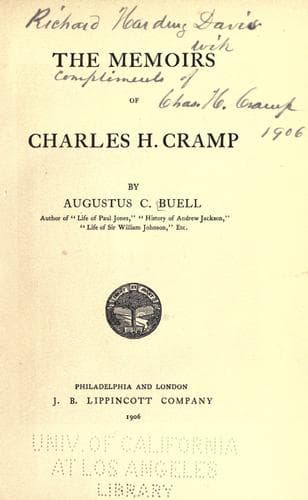
Cramp, Charles Henry, 1828-1913; Naval architects -- United States -- Biography
“We then visited every great marine engine and ship-building works
on the Thames and Clyde, beginning with the Thames, whose shipyards
at that time stood higher in the _art_ of ship-building and in the
proficiency of marine-engine construction than the Clyde shipyards.
When we started on our tour we determined to adhere to a fixed
policy and procedure wherever we went, which was to frankly praise
whatever we thought deserving of it and to adversely criticise
whatever we thought deserved such criticism; and particularly to
make no secret of the principal object of our visit.
“Our Company was practically unknown then in Great Britain, and
steamship building was supposed to be an unknown art in America; but
we were received with much cordiality and frankness, probably from
mere curiosity, if nothing else.
“Fortunately for us, we visited the works of Mr. Zamuda first, where
a capable engineer was delegated to show us around. It having been
noticed that we had registered our names, one as ship-builder and
constructor and the other as marine engineer, the Superintendent was
anxious to have our dimensions taken. There was no time wasted, and
our questions and remarks covering everything in sight or in the
field of ship-building methods were showered on him in a deluge. He
had expected to get through with us in a very short time, thinking
that a sort of perfunctory visit ‘in one door and out at the
opposite’ would be sufficient; but finding that he had been
mistaken, he sent a boy out with a note and soon received an answer.
We spent the greater part of the morning there. When it became noon,
he explained that he had sent a note out to Mr. Zamuda, stating that
we were well up in everything pertaining to the business, etc. Mr.
Zamuda’s reply was to send us in to him when we were through. He
received us with much consideration and politeness, invited us to
take luncheon with him, and devoted much time to questions as to
wages of workmen, materials, and where they were secured, prices,
character of output, etc.
“When he found that we were doing considerable in the way of iron
ship-building, principally coastwise, he was much astonished to know
that most of the workmen as well as Mr. Wilson and myself were
native to the soil, and he had much to say on the subject.
“When he had finished with us, and after we had informed him of the
purpose of our visit and that we wanted to see the principal
shipyards in the country, he stated that he would facilitate our
purpose by giving us letters to the Superintendents of the principal
places; explaining that they would take time to show us what was
worth seeing, while, if we went to the office, we would only be
hurried through in a careless manner.
Public-domain text, read in full here on John Shaqi.
Reviews
Reviews
No reviews yet
Be the first to share your thoughts on this work.
Elsewhere in the archive
Join the Discussion
Join the discussion
Sign in to leave a comment or review.
Sign InorCreate an account