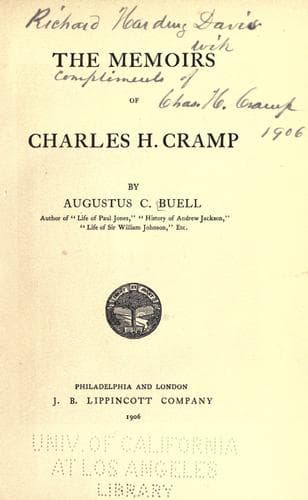
Cramp, Charles Henry, 1828-1913; Naval architects -- United States -- Biography
When this bill was first brought forward, being introduced by Mr. Frye,
of Maine, in the Senate, and by Mr. Dingley, in the House of
Representatives, the foreign steamship owners or their agents in this
country at once became greatly alarmed. They had not offered a very
vigorous resistance to the passage of the Ocean Mail Pay Act of 1891,
because their knowledge of the business and their keen sense of the
situation taught them that there was not much danger to their interests
in that bill. They made a show of opposing it, of course, but they spent
very little money or time and made no really determined effort to beat
it. In fact, the foreign steamship owners and the managers of the
foreign lines which were doing the ocean-carrying trade of the United
States realized before that bill became a law what it took our people
two or three years to find out. But when the tonnage bounty bill was
brought forward, with the general applicability of its provisions to all
kinds of vessels engaged in the foreign carrying trade, and proposing,
as it did, a rate of bounty which would have gone far toward equalizing
the difference in cost of seafaring labor and subsistence as between
American and foreign ships, the owners and managers of the steamship
lines[1] and tramps that were carrying the commerce of the United States
determined that it must be beaten at all hazards and at any cost. This
struggle began in 1894. The original tonnage bill passed the Senate, but
was smothered in the House. The owners and managers of the foreign
steamship lines could not control the Senate, but they appeared able to
affect the action of the House of Representatives negatively, at least,
if not positively.
Footnote 1:
These managers of foreign lines proceeded systematically. Whatever may
have been the activity of their competition for the carrying trade of
the United States, they were unanimous in their determination to
prevent the growth of an American merchant marine. Acting under the
guise of a pretended business combine, which, for convenience, they
termed “The North Atlantic Traffic Association,” they raised funds,
hired lobbyists,—among whom appeared ex-officials of positions as high
as the Cabinet,—and by every possible means known to modern ingenuity
thwarted every effort of those favoring American interests, both in
and out of Congress. This combination has no reason for existence
except that of organized and systematic lobbying against American
interests in the corridors and committee rooms of the American
Congress.
Public-domain text, read in full here on John Shaqi.
Reviews
Reviews
No reviews yet
Be the first to share your thoughts on this work.
Elsewhere in the archive
Join the Discussion
Join the discussion
Sign in to leave a comment or review.
Sign InorCreate an account