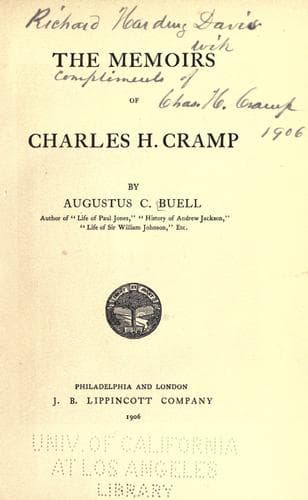
Cramp, Charles Henry, 1828-1913; Naval architects -- United States -- Biography
A similar measure was brought forward again in the Congress elected with
President McKinley in 1896, and the bill passed the Senate, again to
meet the same fate as its predecessor in a Republican House of
Representatives with a thorough working majority, notwithstanding that
the policy of aid to American shipping had been a cardinal plank in the
platform of that year, upon which that House had been elected. The
defection was almost wholly among Western Republicans.
[Illustration: BATTLESHIP NEW IRONSIDES]
During the contest over the bill in the Congress under consideration,
the tactics of the foreign steamship owners and managers, personally as
well as through their hired agents, were a disgrace to the good name of
American legislation. They threw off all disguise and openly lobbied on
the floors and in the corridors and committee rooms of the House to
prevent consideration of the bill. In that Congress there was every
prospect that if the Senate Bill could be brought up for consideration
it would pass with some trifling amendments, which could easily be
adjusted in conference committee. The whole strategy of the alien
shipping interests was to prevent consideration, which they ultimately
succeeded in doing by working upon the susceptibility or the
apprehensions of certain Republicans from the far Western States.
In 1898, the tonnage bounty bill in a modified form was brought forward
again; this time with a limitation of the amount to be expended under
its provisions in any one fiscal year to nine millions of dollars, but
it met the same kind of opposition that had beaten its two predecessors,
and it shared their fate, passing the Senate and being denied
consideration in the House.
Finally, in the Congress elected in 1900 and assembling in 1901, a
tonnage bill still further modified was brought forward and passed the
Senate. For a time it was believed that the alien ship-owners and
managers would not be able to beat this bill as they had its
predecessors, and strong hopes were indulged by its friends that it
would receive consideration in the House. Even up to the last few weeks
of the closing session of the Fifty-seventh Congress which expired March
3, 1903, the Chairman of the Committee on Merchant Marine and other
advocates and friends of the bill believed that they would be able to
get a rule for its consideration even at the last moment. But that hope,
like all the others, passed away.
* * * * *
Public-domain text, read in full here on John Shaqi.
Reviews
Reviews
No reviews yet
Be the first to share your thoughts on this work.
Elsewhere in the archive
Join the Discussion
Join the discussion
Sign in to leave a comment or review.
Sign InorCreate an account