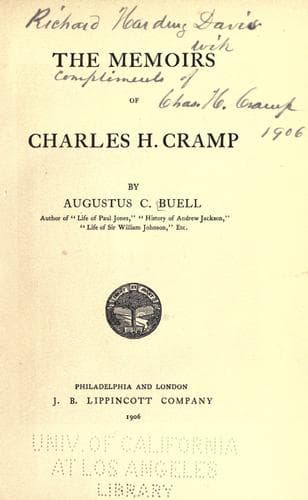
Cramp, Charles Henry, 1828-1913; Naval architects -- United States -- Biography
The phrase viewed as a glittering generality is seductive, and it is
regarded by many people as a mere proposition to enable American
ship-owners to buy their ships where they can get them the cheapest, as
the saying is. It is a curious fact that, with all the learning and the
so-called logic of political economists, they have never yet, from Adam
Smith down, clearly defined to us what really constitutes cheapness in
all its elements, or what constitutes the reverse, or costliness. A mere
difference in dollars and cents for a given thing to perform a certain
work by no means expresses the difference. It may, and often does in
fact, befog or confuse the mind. A bad or poorly constructed thing may
be called cheap, and a good, well-constructed thing may be termed
costly, measured by dollars and cents, and yet practically, in view of
efficiency, durability, and all the other elements of desirability, the
so-called costly thing may be actually cheaper than the so-called cheap
thing, both being intended for the same purpose.
A free ship law, or the repeal of our existing navigation laws, would
unquestionably load our registry with ships cheap in dollars and cents,
but they would prove dear in everything else. In order to do what lay in
his power to correct these misapprehensions and clear away this fog of
ignorance on that particular subject, Mr. Cramp, in the _North American
Review_ for April, 1894, printed a paper entitled “Our Navigation Laws.”
In the course of this paper he called attention to certain facts of
permanent historical value which there seemed a tendency to forget or
ignore:
“At the time of the Franco-German War of 1870-71, even so sturdy a
patriot as General Grant, then President, was persuaded for a time
that it would be a good thing for our commerce, as a neutral nation,
to permit American registry of foreign-built vessels, the theory
being that many vessels of nations which might become involved in
the struggle would seek the asylum of our flag.
“Actuated by powerful New York influence, already conspicuously
hostile to the American merchant marine, General Grant, in a special
message, recommended that Congress enact legislation to that end.
This proposition was antagonized by Judge Kelley, of
Pennsylvania,—always at the front when American interests were
threatened,—in one of his most powerful efforts, couched in the
vehement eloquence of which he was master, which impressed General
Grant so much that he abandoned that policy, and subsequently
adhered to the existing system.
Public-domain text, read in full here on John Shaqi.
Reviews
Reviews
No reviews yet
Be the first to share your thoughts on this work.
Elsewhere in the archive
Join the Discussion
Join the discussion
Sign in to leave a comment or review.
Sign InorCreate an account