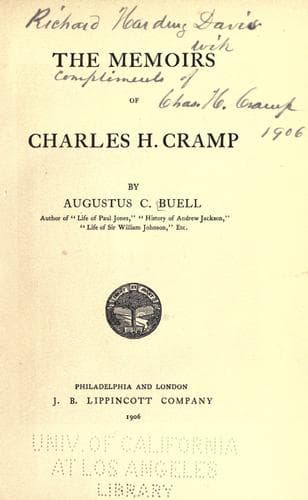
Cramp, Charles Henry, 1828-1913; Naval architects -- United States -- Biography
“I will not stop here to point out in detail the tremendous
political and diplomatic advantage which England would enjoy when
dealing with other maritime powers, if she could have always at hand
an asylum for the lame ducks of her commercial fleet in time of war.
Her ocean greyhounds, that could either escape the enemy’s cruisers
or be readily converted into cruisers themselves, might remain under
her flag; but all her slow freighters, tramps, and obsolete
passenger boats of past eras would be transferred by sham sales to
our flag, under which they could pursue their traffic in safety
during the war under peace rates of insurance, and without any
material diversion of their earnings, which would of course be
increased by war freight rates, returning to their former allegiance
at the end of the war. The lack of such an asylum amounts to a
perpetual bond to keep the peace.
“From the end of the Civil War to about 1880 there was but feeble
effort to revive ship-building in this country. All our energies of
capital and enterprise, as I have remarked elsewhere, were directed
to the extension of railways in every direction, to the repair of
the war ravages in the South, to the settlement of the vast
territories of the West,—in a word, to purely domestic development,
pending which England was by common consent left to enjoy her ocean
monopoly.
“Such was the state of affairs in 1883-85, when the adoption of the
policy of naval reconstruction offered to American ship-building the
first encouragement it had seen in a quarter of a century.
“When we began to build the new navy, every English journal, from
the _London Times_ down, pooh-poohed the idea that a modern
man-of-war could be built in an American yard, modern high-powered
engines in an American machine-shop, or modern breech-loading cannon
in an American forge. Many of the English ship-builders rubbed their
hands in actual anticipation of orders from this government for the
ships and guns needed; and they blandly assured us that they would
give us quite as favorable terms as were accorded to China, Japan,
and Chile. And, to their shame be it said, there were officers of
our navy who not only adopted this view, but did all they could to
commit our government to the pernicious policy.
Public-domain text, read in full here on John Shaqi.
Reviews
Reviews
No reviews yet
Be the first to share your thoughts on this work.
Elsewhere in the archive
Join the Discussion
Join the discussion
Sign in to leave a comment or review.
Sign InorCreate an account