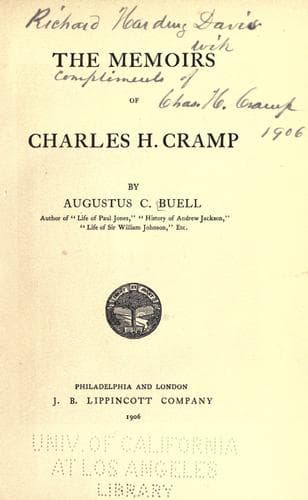
Cramp, Charles Henry, 1828-1913; Naval architects -- United States -- Biography
“In 1885, when Secretary Whitney took control of the Navy
Department, the efforts of English ship-builders to secure at least
a share of the work were renewed. By this time the English were
willing to admit that the hulls of modern ships could be built in
the United States; but they were satisfied that our best policy
would be to buy the necessary engines, cannon, and armor from them.
Secretary Whitney, however, promptly decided that the only article
of foreign production which the new navy needed was the plans of
vessels for comparison. This was wise, because it placed in the
hands of our builders the results of the most mature experience
abroad, at comparatively small cost. But one of the earliest and
firmest decisions of Mr. Whitney was that our naval vessels,
machinery and all, must be built at home and of domestic material.
“The efforts of the English builders to get the engine-work for our
new navy were much more serious and formidable than is generally
known. A prominent member of the House Committee on Naval Affairs
proposed an amendment to a pending naval bill empowering the
Secretary at his discretion to contract abroad for the construction
of propelling machinery for our naval ships. The language was, of
course, general, but every one knows that the term ‘abroad’ in this
sense would be synonymous with Great Britain, and nothing more.
“Mr. Whitney promptly met this proposition with a protest in the
shape of a letter to the Naval Committee dated February 27, 1886. He
said that, so far as he was concerned, he would not avail himself of
such a power if granted. There was no occasion for such power; and
it could have no effect except to keep American builders in
suspense, and thereby augment the difficulty of obtaining capital
for the enlargement of their facilities to meet the national
requirements. Mr. Whitney’s protest was so vigorous that the
proposition died from its effects in the committee and has been
well-nigh forgotten. The proposer himself became satisfied that he
had been misled by the representations of naval officers who were
under English influence, and did not press his amendment.
“I have brought these facts forward for the purpose of emphasizing
my declaration that the promotive influence behind every movement
against our navigation laws is of British origin, and whenever you
put a pin through a free-ship bill you prick an Englishman.
“The portion of Mr. Whitney’s letter referring to the proposed
free-engine clause in the Naval Bill of 1886 was as follows:
Public-domain text, read in full here on John Shaqi.
Reviews
Reviews
No reviews yet
Be the first to share your thoughts on this work.
Elsewhere in the archive
Join the Discussion
Join the discussion
Sign in to leave a comment or review.
Sign InorCreate an account