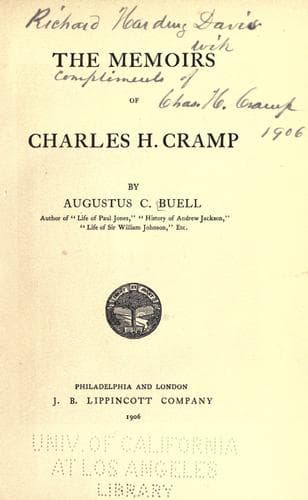
Cramp, Charles Henry, 1828-1913; Naval architects -- United States -- Biography
While this contest was going on between American ship-owners and
ship-builders on the one hand and the alien combinations who control our
ocean commerce on the other, a vast amount of American capital was
gradually invested in shipping under the British flag, and at least an
equal amount awaited any reasonable encouragement to build ships in this
country to sail under the American flag. Of course, it would have been
folly for the men who controlled this capital to invest it in American
ships with a clear handicap of at least 15 to 20 per cent. against them
in operating expenses, ton for ton, in competition with the aided,
fostered, and subsidized fleets of England, Germany, and France. For a
long time this mass of capital was held in hope of the adoption of a
policy by our government that would tend to lift the handicap and
equalize as far as possible the burdens of operating American ships as
compared with others. But when Congress adjourned March 4, 1901, leaving
the shipping question where it had been ever since the Civil War, and
offering, if possible, less hope than ever before, the mass of American
capital that had been held back was let loose. Soon rumors that a great
merger of British steamship lines with the International Navigation
Company was in progress filled the air. It soon appeared that there was
plenty of American capital to invest in ships under foreign flags, but
none under the American flag so long as the existing situation might
last. The ship-owners may have been patriotic, but their patriotism was
not enthusiastic enough to make them willing to pay a penalty of 15 to
20 per cent. for the sake of it. This movement soon took shape in the
organization of the International Mercantile Marine Company, in which
was merged the control and management of the International, the White
Star, the Leyland, and the Atlantic Transport Lines; the whole forming
by far the greatest aggregation of vessels and tonnage ever grouped
under one control. This control was American,[2] but the ships were of
British registry except six, built by the Cramps and several others,—the
“St. Louis,” “St. Paul,” “Kroonland,” and “Finland,” American built, and
the “New York” and “Philadelphia” (formerly the “Paris”), British built,
but admitted to American registry by the special Act of 1892.
Footnote 2:
Since this was written, the whole ownership of the Line is British.
Public-domain text, read in full here on John Shaqi.
Reviews
Reviews
No reviews yet
Be the first to share your thoughts on this work.
Elsewhere in the archive
Join the Discussion
Join the discussion
Sign in to leave a comment or review.
Sign InorCreate an account