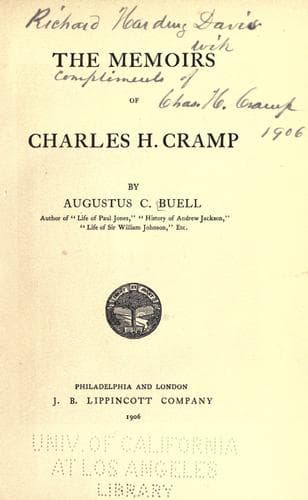
Cramp, Charles Henry, 1828-1913; Naval architects -- United States -- Biography
Such were the conditions which confronted the ship-builders who made
estimates and offered bids for the construction of the four pioneer
steel ships of the new navy. When the bids were opened early in July,
1883, it became apparent that the views of bidders as to the character
of the task they proposed to undertake were quite divergent. To avoid
prolixity, we will deal only with the “Chicago,” which was, in fact, the
representative ship. For that vessel there were but two bidders worth
considering,—Mr. Cramp and Mr. Roach. Mr. Roach bid $889,000 for the
hull and machinery. Mr. Cramp bid a little over $1,000,000, or about 14
per cent. in excess of his competitor. As the sequel proved, Mr. Cramp,
conservative as his bid was, or as it appeared to be, underwent no
misfortune in failing to get the “Chicago” at $1,025,000. Whether Mr.
Cramp could have been more successful than Mr. Roach was in creating the
new open-hearth steel industry required to produce the material demanded
by the law and the specifications need not be discussed. It may,
however, be said that the excess of his bid over that of Mr. Roach was
due wholly to his misgivings on this point; because on all other points
involved, such as experience, skill, and efficiency of organization, he
had some advantage.
Mr. Roach got all the ships. The contracts were signed July 26, 1883.
The keel of the “Chicago” was laid December 5, 1883; she was launched
December 5, 1885, only fifty-two days before the contract date for
completion, which was January 26, 1886. Meantime the first of the ships,
the despatch-boat “Dolphin,” had been completed, put on trial, and had
failed to meet the requirements of the law. Here the evils of the
inflexible, inelastic, or “cast-iron” form of contract became instantly
evident. The Navy Department could not accept the ship under those
conditions without violating the law. Mr. Roach thereupon threw up his
hands, and the government, as provided in the contract, had to take
possession of the ships as they stood in his shipyard and complete them
with its own resources, at the risk and expense of Mr. Roach and his
bondsmen. This action on his part is hard to understand or explain. He
was perfectly solvent. Although, as the law and the contract stood, the
Navy Department could not accept the “Dolphin,” in view of her
deficiency in performance, Congress was soon to assemble, and Secretary
Whitney was ready to ask for an amendment or modification of the law
which would enable him to accept the ship with an equitable penalty for
her deficiency, which, by the way, was not great. It was said at the
time that Mr. Roach acted upon the advice of certain political friends
holding high rank; that a certain group of Republican politicians
believed that their party needed a martyr just at that juncture, and
they thought Mr. Roach would make a good one. Be this as it may, the
government finished all the ships in the Roach yard, and the “Chicago,”
Public-domain text, read in full here on John Shaqi.
Reviews
Reviews
No reviews yet
Be the first to share your thoughts on this work.
Elsewhere in the archive
Join the Discussion
Join the discussion
Sign in to leave a comment or review.
Sign InorCreate an account