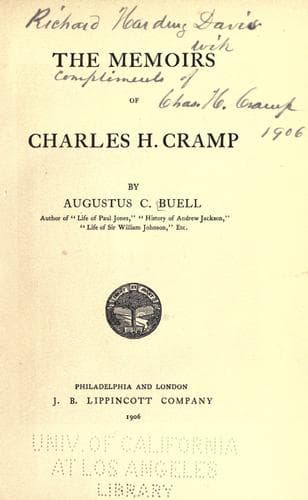
Cramp, Charles Henry, 1828-1913; Naval architects -- United States -- Biography
Verbally, this was the English Admiralty standard for mild steel plates
and shapes. But the English had an elastic system of inspection which
left much to be determined by the judgment and knowledge of the
inspector. The system adopted by our earlier inspectors of material was
rigid as a rock and inelastic as cast-iron. The letter of the law, not
the spirit of it, was their guide. These requirements and the mode of
enforcing them would have been drastic had the mild-steel industry been
in a flourishing condition. But as a matter of fact it had not been
developed at all in this country; so they were formulating crucial
requirements for the product of an industry which did not exist. The
production of mild steel, or at least its use in naval construction, was
still in the experimental stage then, even in England, its native home.
The “Iris” and “Mercury,” the first all-steel ships built in England,
had not been in commission more than two years, when the requirements
for our new ships were formulated by the naval authorities and embodied
in an Act of Congress.
Bessemer steel was produced in large quantities here at the time for
making rails and tank-plates. But Bessemer could not stand the navy
tests. Nothing but open-hearth steel could do it, and at the time when
bids were asked for the first four ships there was not an open-hearth
mill in the country that could make the ingots required for the plates
and shapes of the sizes and qualities demanded. Still, American
steel-makers were found willing to undertake the task, though the sequel
soon proved that their conceptions of what confronted them were quite
vague. When one surveys the open-hearth steel industry as it exists in
the United States to-day (1901), largely exceeding that of Great
Britain, and greater than that of all the rest of the world, exclusive
of the United Kingdom, put together, it seems impossible to realize that
it is all the growth of a score of years. As late as 1887 there was no
forging-mill in this country that could forge a three-throw crank-shaft
in one piece, and the “Baltimore’s” crank-shafts of that description had
to be imported from Whitworth’s works in England.
Public-domain text, read in full here on John Shaqi.
Reviews
Reviews
No reviews yet
Be the first to share your thoughts on this work.
Elsewhere in the archive
Join the Discussion
Join the discussion
Sign in to leave a comment or review.
Sign InorCreate an account