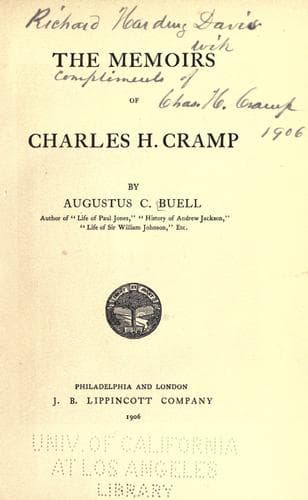
Cramp, Charles Henry, 1828-1913; Naval architects -- United States -- Biography
“The hulls of these vessels had been designed by the Advisory Board,
and were about equal to any vessels constructed abroad at that time
so far, I might say, as the models and general designs were
concerned. Their outfit and guns were not fairly up to the
prevailing practice abroad, and their engines were very inefficient
and commonplace. They were not designed by the board, but were
principally the designs of the contractor. The ‘Chicago’ had engines
of quite a fantastic design, suggested by one of the members in the
board. The models and designs of the hulls, as compared with what
had preceded them in the Navy Department after the end of the Civil
War, were great achievements over the ridiculous specimens of the
ship-building art that we were loaded with during that time. They
were the production principally of Messrs. Steers and Fernald,
assisted by Mr. Bowles, and were up to most of the requirements of
the time.
“When the vessels were tried under the following Administration,
that is, during the Secretaryship of Mr. Whitney, it was found that
the power of the engines and the consequent speed developed were not
up to the requirements of the law, although it might be said that
they were up to the requirements of the contract.
“There was some considerable delay on the part of the Secretary, Mr.
Whitney, in receiving the ships from the contractors on that
particular account, a decision having been made by the
Attorney-General that vessels contracted for and subsequently not
coming up to the requirements and not in full accordance with the
law were worthless, and would not be accepted.
“A violent uproar pervaded the entire country at that time on
account of what they called the hesitating attitude of Mr. Whitney.
“The political administration of the government having changed, it
was asserted that it was on account of the politics of the
contractor that the vessels had not been accepted. Among the people
who argued thus, all considerations of contract requirements of law
were entirely ignored, and Mr. Whitney received untold denunciations
from these sources; but he was one of those men whom adverse
criticisms as to what he had done never disturb in the slightest
degree.
“Mr. Whitney finally accepted the vessels conditionally, after more
or less contention which consumed some little time. But no more
unfair denunciation or criticism of the actions and efforts of any
man ever occurred than fell to his lot at that time.
“The second lot of vessels was given out by Mr. Whitney, who
succeeded Mr. Chandler. Two of these vessels were built on plans
provided by Mr. Whitney, and two were on modified plans of Mr.
Chandler.
Public-domain text, read in full here on John Shaqi.
Reviews
Reviews
No reviews yet
Be the first to share your thoughts on this work.
Elsewhere in the archive
Join the Discussion
Join the discussion
Sign in to leave a comment or review.
Sign InorCreate an account