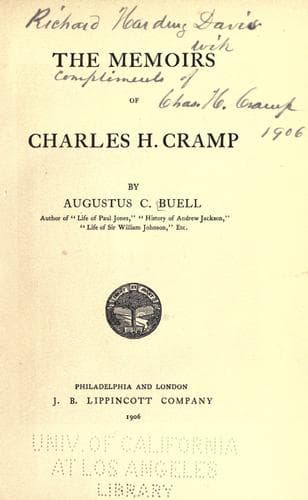
Cramp, Charles Henry, 1828-1913; Naval architects -- United States -- Biography
“In compliance with the provisions of the act which authorized the
‘Secretary to prepare drawings,’ Mr. Whitney purchased from
Armstrong the drawings that had been prepared for the Spanish
government, and the drawings of the ‘Naniwa Khan,’ which ship they
had built for Japan. These two vessels became the ‘Baltimore’ and
‘Charleston.’ Cruiser No. 1 of Mr. Chandler’s plans was not given
out; as the bids were above the limitation price, the smaller
cruiser was given out under modified conditions. This vessel became
the ‘Yorktown.’
“Before the advertisement was printed, Mr. Whitney invited all of
the expectant bidders to examine the plans and specifications which
he had purchased, and without exception all recorded their
indorsement, and some in extravagant terms. After Mr. Whitney’s
retirement, the contractor who had indorsed them in the most
extravagant manner was the first and only one to find fault.
“We bid on all the vessels and in accordance with the conditions of
the advertisement with the exception of that of the ‘Yorktown.’ On
that vessel we bid on the government designs, and designs of our own
which embodied a proposition to install the first triple-expansion
engines in the navy. Our bid for the ‘Newark’ being higher than the
government allowance, we did not get her. As I said before, she was
not awarded.
“When it was found that Mr. Whitney had purchased abroad the
drawings that I have already referred to,—the drawings of the
vessels that ultimately came to be the ‘Baltimore’ and
‘Charleston,’—he was fiercely assailed by certain parties in the
Navy Department, while certain others indorsed his action; but the
Bureau of Construction and Repair and the Bureau of Steam
Engineering were conspicuous in their opposition. The most
conspicuous in support of the Secretary was Commodore Walker. We
received our share of adverse criticism because we had indorsed the
steps he had taken.
“The design of the ‘Baltimore’ and the ‘Charleston’ represented the
best types of vessels that were constructed up to that time. They
were far in advance of any other war-ships of that period, and in
fact they really formed the basis of future constructions in the
world’s navies.
Public-domain text, read in full here on John Shaqi.
Reviews
Reviews
No reviews yet
Be the first to share your thoughts on this work.
Elsewhere in the archive
Join the Discussion
Join the discussion
Sign in to leave a comment or review.
Sign InorCreate an account