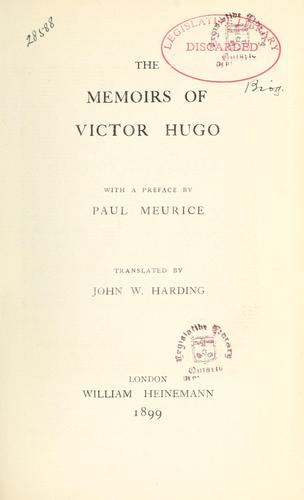
Authors, French -- 19th century -- Biography; Autobiographies; Hugo, Victor, 1802-1885
The two women seated beside the President had square-topped chairs. The
President’s chair was surmounted with a little round top. As I was about
to draw some inference from this I looked at the other chairs and saw
that four or five guests, myself among them, had chairs similar to that
of the President. The chairs were covered with red velvet with gilt
headed nails. A more serious thing I noticed was that everybody
addressed the President of the Republic as “Monseigneur” and “your
Highness.” I who had called him “Prince,” had the air of a demagogue.
When we rose from table the Prince asked after my wife, and then
apologized profusely for the rusticity of the service.
“I am not yet installed,” he said. “The day before yesterday, when I
arrived here, there was hardly a mattress for me to sleep upon.”
The dinner was a very ordinary one, and the Prince did well to excuse
himself. The service was of common white china and the silverware
bourgeois, worn, and gross. In the middle of the table was a rather fine
vase of craquelé, ornamented with ormolu in the bad taste of the time of
Louis XVI.
However, we heard music in an adjoining hall.
“It is a surprise,” said the President to us, “they are the musicians
from the Opera.”
A minute afterwards programmes written with a pen were handed round.
They indicated that the following five selections were being played:
1. Priere de la “Muette.”
2. Fantaisie sur des airs favoris de la “Reine Hortense.”
3. Final de “Robert Bruce”.
4. “Marche Republicaine.”
5. “La Victoire,” pas redoublé.
In the rather uneasy state of mind I, like the whole of France, was in
at that moment, I could not help remarking this “Victory” piece coming
after the “Republican March.”
I rose from table still hungry.
We went into the grand salon, which was separated from the dining-room
by the smaller salon that I had passed through on entering.
This grand salon was extremely ugly. It was white, with figures
on panels, after the fashion of those of Pompeii, the whole of the
furniture being in the Empire style with the exception of the armchairs,
which were in tapestry and gold and in fairly good taste. There were
three arched windows to which three large mirrors of the same shape at
the other end of the salon formed pendants and one of which, the middle
one, was a door. The window curtains were of fine white satin richly
flowered.
While the Prince de la Moskowa and I were talking Socialism, the
Mountain, Communism, etc., Louis Bonaparte came up and took me aside.
Public-domain text, read in full here on John Shaqi.
Reviews
Reviews
No reviews yet
Be the first to share your thoughts on this work.
Elsewhere in the archive
Join the Discussion
Join the discussion
Sign in to leave a comment or review.
Sign InorCreate an account