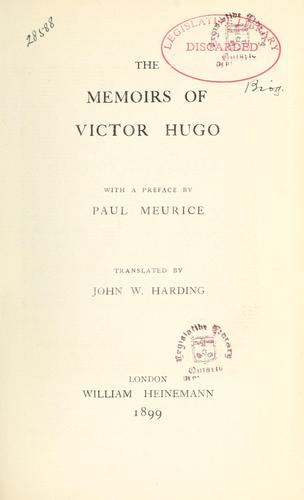
Authors, French -- 19th century -- Biography; Autobiographies; Hugo, Victor, 1802-1885
He asked me what I thought of the situation. I was reserved. I told him
that a good beginning had been made; that the task was a difficult but
a grand one; that what he had to do was to reassure the bourgeoisie
and satisfy the people, to give tranquillity to the former, work to the
latter, and life to all; that after the little governments, those of the
elder Bourbons, Louis Philippe, and the Republic of February, a great
one was required; that the Emperor had made a great government through
war, and that he himself ought to make a great one through peace; that
the French people having been illustrious for three centuries did not
propose to become ignoble; that it was his failure to appreciate this
high-mindedness of the people and the national pride that was the chief
cause of Louis Philippe’s downfall; that, in a word, he must decorate
peace.
“How?” asked Louis Napoleon.
“By all the greatness of art, literature and science, by the victories
of industry and progress. Popular labour can accomplish miracles. And
then, France is a conquering nation; when she does not make conquests
with the sword, she wants to make them with the mind. Know this and act
accordingly. Ignore it and you will be lost.”
He looked thoughtful and went away. Then he returned, thanked me warmly,
and we continued to converse.
We spoke about the press. I advised him to respect it profoundly and
at the same time to establish a State press. “The State without a
newspaper, in the midst of newspapers,” I observed, “restricting itself
to governing while publicity and polemics are the rule, reminds one
of the knights of the fifteenth century who obstinately persisted in
fighting against cannon with swords; they were always beaten. I grant
that it was noble; you will grant that it was foolish.”
He spoke of the Emperor. “It is here,” he said, “that I saw him for the
last time. I could not re-enter this palace without emotion. The Emperor
had me brought to him and laid his hand on my head. I was seven years
old. It was in the grand salon downstairs.”
Then Louis Bonaparte talked about La Malmaison. He said:
“They have respected it. I visited the place in detail about six weeks
ago. This is how I came to do so. I had gone to see M. Odilon Barrot at
Bougival.
“‘Dine with me,’ he said.
“’ I will with pleasure.’ It was 3 o’clock. ‘What shall we do until
dinner time?’
“‘Let us go and see La Malmaison,’ suggested M. Barrot.
“We went. Nobody else was with us. Arrived at La Malmaison we rang the
bell. A porter opened the gate, M. Barrot spoke:
“‘We want to see La Malmaison.’
“‘Impossible!’ replied the porter.
“‘What do you mean, impossible?’
“‘I have orders.’
“‘From whom?’
“‘From her Majesty Queen Christine, to whom the château belongs at
present.’
“‘But monsieur here is a stranger who has come expressly to visit the
place.’
“‘Impossible!’
“‘Well,’ exclaimed M. Odilon Barrot, ‘it’s funny that this door should
be closed to the Emperor’s nephew!’
Public-domain text, read in full here on John Shaqi.
Reviews
Reviews
No reviews yet
Be the first to share your thoughts on this work.
Elsewhere in the archive
Join the Discussion
Join the discussion
Sign in to leave a comment or review.
Sign InorCreate an account