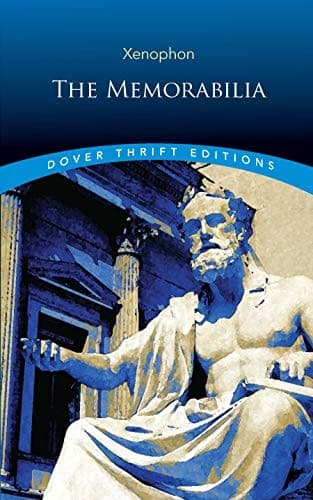
Classical literature; Philosophers, Ancient -- Biography -- Early works to 1800; Socrates -- Trials, litigation, etc. -- Early works to 1800
Then Euthydemus: It is the poverty of my own wit which forces me to this
admission. I bethink me it is high time to keep silence altogether; a
little more, and I shall be proved to know absolutely nothing. And so he
went away crestfallen, in an agony of self-contempt, persuaded that he
was verily and indeed no better than a slave.
Amongst those who were reduced to a like condition by Socrates, many
refused to come near him again, whom he for his part looked upon as
dolts and dullards. (59) But Euthydemus had the wit to understand that,
in order to become worthy of account, his best plan was to associate
as much as possible with Socrates; and from that moment, save for some
necessity, he never left him--in some points even imitating him in his
habits and pursuits. Socrates, on his side, seeing that this was the
young man's disposition, disturbed him as little as possible, but in the
simplest and plainest manner initiated him into everything which he held
to be needful to know or important to practise.
(59) Or, "as people of dull intelligence and sluggish temperament."
Cf. Plat. "Gorg." 488 A.
III
It may be inferred that Socrates was in no hurry for those who were
with him to discover capacities for speech and action or as
inventive geniuses, (1) without at any rate a well-laid foundation of
self-control. (2) For those who possessed such abilities without these
same saving virtues would, he believed, only become worse men with
greater power for mischief. His first object was to instil into those
who were with him a wise spirit in their relation to the gods. (3) That
such was the tenor of his conversation in dealing with men may be
seen from the narratives of others who were present on some particular
occasion. (4) I confine myself to a particular discussion with
Euthydemus at which I was present.
(1) Or, "as speakers" (see ch. vi. below), "and men of action" (see
ch. v. below), "or as masters of invention" (see ch. vii. below).
(2) Or, "but as prior to those excellences must be engrafted in them
{sophrosune} (the virtues of temperance and sanity of soul)."
(3) Lit. "His first object and endeavour was to make those who were
with him {sophronas} (sound of soul) as regards the gods."
(4) Reading after Herbst, Cobet, etc., {diegountai}, or if vulg.
{diegounto}, translate, "from the current accounts penned during
his lifetime by the other witnesses." For {alloi} see K. Joel, op.
cit. pp. 15, 23; above, "Mem." I. iv. 1.
Socrates said: (5) Tell me, Euthydemus, has it ever struck you to
observe what tender pains the gods have taken to furnish man with all
his needs?
(5) For the subject matter of this "teleological" chapter, see above,
I. iv.; K. Joel, op. cit. Appendix, p. 547 foll. in ref. to
Dummler's views.
Euth. No indeed, I cannot say that it has ever struck me.
Well (Socrates continued), you do not need to be reminded that, in the
first place, we need light, and with light the gods supply us.
Public-domain text, read in full here on John Shaqi.
Reviews
Reviews
No reviews yet
Be the first to share your thoughts on this work.
Elsewhere in the archive
Join the Discussion
Join the discussion
Sign in to leave a comment or review.
Sign InorCreate an account