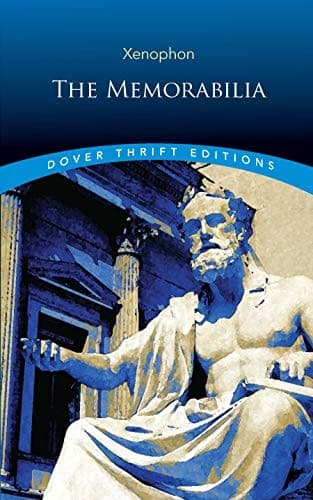
Classical literature; Philosophers, Ancient -- Biography -- Early works to 1800; Socrates -- Trials, litigation, etc. -- Early works to 1800
Soc. Yes, and you will discover for yourself the truth of what I say, if,
without waiting to behold the outward and visible forms (20) of the gods
themselves, you will be content to behold their works; and with these
before you, to worship and honour the Divine authors of them. (21)
I would have you reflect that the very gods themselves suggest this
teaching. (22) Not one of these but gives us freely of his blessings;
yet they do not step from behind their veil in order to grant one
single boon. (23) And pre-eminently He who orders and holds together
the universe, (24) in which are all things beautiful and good; (25) who
fashions and refashions it to never-ending use unworn, keeping it free
from sickness or decay, (26) so that swifter than thought it ministers
to his will unerringly--this God is seen to perform the mightiest
operations, but in the actual administration of the same abides himself
invisible to mortal ken. Reflect further, this Sun above our heads, so
visible to all--as we suppose--will not suffer man to regard him too
narrowly, but should any essay to watch him with a shameless stare he
will snatch away their power of vision. And if the gods themselves are
thus unseen, so too shall you find their ministers to be hidden also;
from the height of heaven above the thunderbolt is plainly hurled, and
triumphs over all that it encounters, yet it is all-invisible, no eye
may detect its coming or its going at the moment of its swoop. The winds
also are themselves unseen, though their works are manifest, and through
their approach we are aware of them. And let us not forget, the soul
of man himself, which if aught else human shares in the divine--however
manifestly enthroned within our bosom, is as wholly as the rest hidden
from our gaze. These things you should lay to mind, and not despise
the invisible ones, but learn to recognise their power, as revealed in
outward things, and to know the divine influence. (27)
(20) Cf. Cic. "de N. D." I. xii. 31; Lactantius, "de Ira," xi. 13.
(21) See L. Dindorf ad loc. (ed. Ox. 1862), {theous}; G. Sauppe, vol.
iii. "An. crit." p. xxix; R. Kuhner; C. Schenkl.
(22) i.e. "that man must walk by faith." For {upodeiknunai} cf.
"Econ." xii. 18.
(23) Schneid. cf. Plat. "Crat." 396.
(24) Or, "the co-ordinator and container of the universe."
(25) Or, "in whom all beauty and goodness is."
(26) Cf. "Cyrop." VIII. vii. 22; above, I. iv. 13.
(27) {to daimonion}, the divinity.
Nay, Socrates (replied Euthydemus), there is no danger I shall turn a
deaf ear to the divine influence even a little; of that I am not afraid,
but I am out of heart to think that no soul of man may ever requite the
kindness of the gods with fitting gratitude.
Public-domain text, read in full here on John Shaqi.
Reviews
Reviews
No reviews yet
Be the first to share your thoughts on this work.
Elsewhere in the archive
Join the Discussion
Join the discussion
Sign in to leave a comment or review.
Sign InorCreate an account