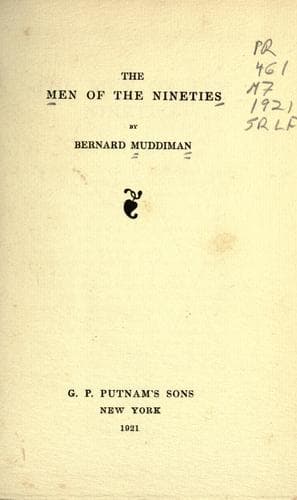
Art -- England; English literature -- 19th century -- History and criticism
A delicate valetudinarian always in search of health, he was born at
Petrograd in March, 1861. He commenced life in the surrogate of New
York State, whither his parents removed, writing in his spare time in
the eighties, under the _nom-de-plume_ of Sidney Luska, sketches of
American Jewish life. Like Theodore Peters, Whistler, and Henry James,
he could not, however, resist the call of the Old World, and he was
at journalistic work in London when he was made editor of _The Yellow
Book_. Besides his editorial duties he was a regular contributor, not
only writing the series of notes signed ‘The Yellow Dwarf,’ but also
turning out a number of short stories. But London was only to be a
haven of brief sojourn for this writer, whose health sent him south
to Italy. Perhaps his best work in the nineties was his short story
_Mademoiselle Miss_, while later in Italy he opened up a new vein of
dainty comedy fiction in almost rose-leaf prose with _The Cardinal’s
Snuff-Box_ (1900), whose happy delicacy of thought and style he never
equalled again, but was always essaying to repeat until death carried
him off in Italy. Although, therefore, sitting in the editorial chair
at the Bodley Head, Harland can only be said to have been a bird of
passage in the nineties, and not one of its pillars like Arthur Symons
of _The Savoy_.
This later publication was started as a rival to _The Yellow Book_
soon after Beardsley gave up the art-editing of the earlier periodical.
In 1895, when ‘Symons and Dowson, Beardsley and Conder, were all
together on a holiday at Dieppe ... it was there, in a cabaret Mr.
Sickert has repeatedly painted, that _The Savoy_ was originated.’[9] It
was issued by Leonard Smithers, the most extraordinary publisher, in
some respects, of the nineties, a kind of modern Cellini, who produced
some wonderfully finely printed books, and was himself just as much a
part of the movement as any of its numerous writers. Indeed, no survey
of the period can be complete without a brief consideration of this man.
[9] W. G. Blaikie Murdoch’s _Renaissance of the Nineties_, p.
21. 1911.
Public-domain text, read in full here on John Shaqi.
Reviews
Reviews
No reviews yet
Be the first to share your thoughts on this work.
Join the Discussion
Join the discussion
Sign in to leave a comment or review.
Sign InorCreate an account