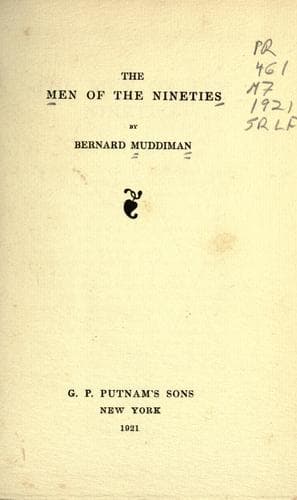
Art -- England; English literature -- 19th century -- History and criticism
But the writer who was to bring irony in English literature to a
consummate pitch, and add to the age a strange brief brilliance of
his own wilful spirit, was Max Beerbohm. Max, the ‘Incomparable’ as
Bernard Shaw once described him, is the charm of the gilded lily, the
fairy prince of an urbane artificiality: he is in literature what the
cocktail is among drinks; he is the enemy of dullness and the friend of
that Greek quality called ‘charis.’ He is the public school and Varsity
man who is fond of, but afraid of, being tedious in literature; so with
delightful affectation his vehicle is persiflage with a load of wit he
pretends to disdain. Of all the prose writers of the Beardsley period
he is the easiest and most charming to read. In fact, he is the ideal
essayist. He titillates the literary sense. Fortunately his glass is
small, for if one had to drink it in quart pots the result would be
as disastrous as in his one and only mistake--the long novel _Zuleika
Dobson_, which is a late work written long after the nineties had been
swallowed up by that maw which swallowed up Lesbia’s sparrow and all
other beautiful dead things.
Max said in jest, ‘I belong to the Beardsley period,’ and it is one of
those jests which is only too painfully true. When he was at Oxford he
was caught up in the movement, and wrote, under Wilde’s influence, _A
Defence of Cosmetics_ for the first number of _The Yellow Book_, and
he also appeared in Lord Alfred Douglas’s magazine. Thenceforward he
contributed to various quarterlies, while in 1896 the little red volume
with its white paper label appeared as _The Works_, containing all the
best of this precocious _enfant terrible_ of literature, who assures
us that he read in bed, while at school, _Marius the Epicurean_, and
found it not nearly so difficult as _Midshipman Easy_. At the age of
twenty-five he cries: ‘I shall write no more. Already I feel myself to
be a trifle outmoded,’ and he religiously does not keep his word. He
keeps pouring out caricatures, writes _More_, the companion volume to
_The Works_, and perpetrates his short story _The Happy Hypocrite_.
Beyond 1899 we cannot follow him, but he has been busy ever since with
his parodies, his _Yet Again_, his lamentable novel, his one-act play,
and so on.
It is to that Beardsley period to which he said he belonged we are
here restricted. And it must be admitted that though the Boer War and
the Great War do not seem to have gagged him, there is something so
impishly impudent in his earlier work which renders it more remarkable
than the complacent efforts of his later years.
Public-domain text, read in full here on John Shaqi.
Reviews
Reviews
No reviews yet
Be the first to share your thoughts on this work.
Join the Discussion
Join the discussion
Sign in to leave a comment or review.
Sign InorCreate an account