Prohibition -- Moral and ethical aspects; Prohibition -- United States
That National Prohibition is an approaching enemy to free government, of
which the people should be warned even at the risk of being grossly
misunderstood, is my opinion. From the watch-towers of American liberty
the warning should go forth. For my own part, I feel well-repaid with
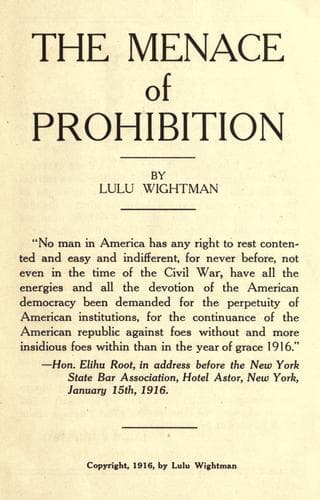
the conscientious effort I have made in "The Menace of Prohibition."
LULU WIGHTMAN.
[Illustration: LULU WIGHTMAN.]
CONTENTS
PAGE
A False Principle 6
Political Power the Object 9
Political Activities at Washington 10
Prohibition and Sunday Laws 13
Sumptuary Laws Increasing 14
A Dangerous Combination 17
An Old-Time Fallacy 21
Industrial Conditions Responsible 23
The Opinion of an Economist 24
Effects of Prohibition 26
Collective Tyranny in Government 29
Prohibition Censorship Despotic 30
We hold these truths to be self-evident: that all men are created
equal; that they are endowed by their Creator with certain
inalienable rights; that among these are life, liberty, and the
pursuit of happiness.--_The Declaration of Independence._
=John Stuart Mill defines Prohibition in this language:=
"Prohibition: A theory of 'social rights' which is nothing short of
this--that it is the absolute right of every individual that every other
individual shall act in every respect exactly as he ought; that
whosoever fails thereof in the smallest particular violates my social
rights and entitles me to demand from the legislature the removal of the
grievance. So monstrous a principle is far more dangerous than any
single interference with liberty;--there is no violation of liberty
which it would not justify."
And in the light of the last sentence, "so monstrous a principle is far
more dangerous than any single interference with liberty;--there is no
violation of liberty which it would not justify," the writer would
especially examine this modern crusaders movement for Prohibition. Many
other writers have viewed the question from sociological, economic, and
religious standpoints; but the =principle= of the thing,--that in which it
is based--a "monstrous" principle, which, as Mill says, "=is far more
dangerous than any single interference with liberty=," deserves more
serious consideration than any other phase of the question: a principle,
in fact, of intolerant coercion as against the great principle of
individual liberty so thoroughly established as the inherent right of
the citizen at the very inception of this government in the Western
world.
Public-domain text, read in full here on John Shaqi.
Reviews
Reviews
No reviews yet
Be the first to share your thoughts on this work.
Join the Discussion
Join the discussion
Sign in to leave a comment or review.
Sign InorCreate an account