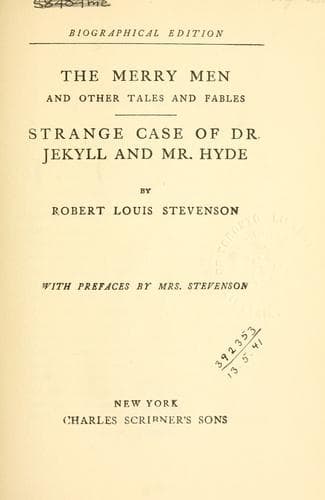
The Merry Men, and Other Tales and FablesStevenson, Robert Louis
History
The Merry Men, and Other Tales and Fables
Stevenson, Robert Louis
Boys -- Fiction; Great Britain -- History -- 19th century -- Fiction; Paranormal fiction; Treasure troves -- Fiction
When the cries had ceased, there came a scraping at the door, by which
I knew Felipe was without; and Olalla went and spoke to him—I know not
what. With that exception, she stayed close beside me, now kneeling by
my bed and fervently praying, now sitting with her eyes upon mine. So
then, for these six hours I drank in her beauty, and silently perused
the story in her face. I saw the golden coin hover on her breaths; I
saw her eyes darken and brighter, and still speak no language but that
of an unfathomable kindness; I saw the faultless face, and, through the
robe, the lines of the faultless body. Night came at last, and in the
growing darkness of the chamber, the sight of her slowly melted; but
even then the touch of her smooth hand lingered in mine and talked with
me. To lie thus in deadly weakness and drink in the traits of the
beloved, is to reawake to love from whatever shock of disillusion. I
reasoned with myself; and I shut my eyes on horrors, and again I was
very bold to accept the worst. What mattered it, if that imperious
sentiment survived; if her eyes still beckoned and attached me; if now,
even as before, every fibre of my dull body yearned and turned to her?
Late on in the night some strength revived in me, and I spoke:—
“Olalla,” I said, “nothing matters; I ask nothing; I am content; I love
you.”
She knelt down awhile and prayed, and I devoutly respected her
devotions. The moon had begun to shine in upon one side of each of the
three windows, and make a misty clearness in the room, by which I saw
her indistinctly. When she rearose she made the sign of the cross.
“It is for me to speak,” she said, “and for you to listen. I know; you
can but guess. I prayed, how I prayed for you to leave this place. I
begged it of you, and I know you would have granted me even this; or if
not, O let me think so!”
“I love you,” I said.
“And yet you have lived in the world,” she said; after a pause, “you
are a man and wise; and I am but a child. Forgive me, if I seem to
teach, who am as ignorant as the trees of the mountain; but those who
learn much do but skim the face of knowledge; they seize the laws, they
conceive the dignity of the design—the horror of the living fact fades
from their memory. It is we who sit at home with evil who remember, I
think, and are warned and pity. Go, rather, go now, and keep me in
mind. So I shall have a life in the cherished places of your memory: a
life as much my own, as that which I lead in this body.”
Public-domain text, read in full here on John Shaqi.
Reviews
Reviews
No reviews yet
Be the first to share your thoughts on this work.
Elsewhere in the archive
Join the Discussion
Join the discussion
Sign in to leave a comment or review.
Sign InorCreate an account