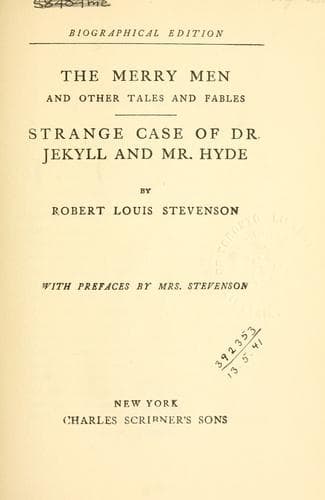
The Merry Men, and Other Tales and FablesStevenson, Robert Louis
History
The Merry Men, and Other Tales and Fables
Stevenson, Robert Louis
Boys -- Fiction; Great Britain -- History -- 19th century -- Fiction; Paranormal fiction; Treasure troves -- Fiction
“I love you,” I said once more; and reaching out my weak hand, took
hers, and carried it to my lips, and kissed it. Nor did she resist, but
winced a little; and I could see her look upon me with a frown that was
not unkindly, only sad and baffled. And then it seemed she made a call
upon her resolution; plucked my hand towards her, herself at the same
time leaning somewhat forward, and laid it on the beating of her heart.
“There,” she cried, “you feel the very footfall of my life. It only
moves for you; it is yours. But is it even mine? It is mine indeed to
offer you, as I might take the coin from my neck, as I might break a
live branch from a tree, and give it you. And yet not mine! I dwell, or
I think I dwell (if I exist at all), somewhere apart, an impotent
prisoner, and carried about and deafened by a mob that I disown. This
capsule, such as throbs against the sides of animals, knows you at a
touch for its master; ay, it loves you! But my soul, does my soul? I
think not; I know not, fearing to ask. Yet when you spoke to me your
words were of the soul; it is of the soul that you ask—it is only from
the soul that you would take me.”
“Olalla,” I said, “the soul and the body are one, and mostly so in
love. What the body chooses, the soul loves; where the body clings, the
soul cleaves; body for body, soul to soul, they come together at God’s
signal; and the lower part (if we can call aught low) is only the
footstool and foundation of the highest.”
“Have you,” she said, “seen the portraits in the house of my fathers?
Have you looked at my mother or at Felipe? Have your eyes never rested
on that picture that hangs by your bed? She who sat for it died ages
ago; and she did evil in her life. But, look again: there is my hand to
the least line, there are my eyes and my hair. What is mine, then, and
what am I? If not a curve in this poor body of mine (which you love,
and for the sake of which you dotingly dream that you love me) not a
gesture that I can frame, not a tone of my voice, not any look from my
eyes, no, not even now when I speak to him I love, but has belonged to
others? Others, ages dead, have wooed other men with my eyes; other men
have heard the pleading of the same voice that now sounds in your ears.
The hands of the dead are in my bosom; they move me, they pluck me,
they guide me; I am a puppet at their command; and I but reinform
features and attributes that have long been laid aside from evil in the
quiet of the grave. Is it me you love, friend? or the race that made
me? The girl who does not know and cannot answer for the least portion
of herself? or the stream of which she is a transitory eddy, the tree
of which she is the passing fruit? The race exists; it is old, it is
ever young, it carries its eternal destiny in its bosom; upon it, like
waves upon the sea, individual succeeds to individual, mocked with a
semblance of self-control, but they are nothing. We speak of the soul,
but the soul is in the race.”
Public-domain text, read in full here on John Shaqi.
Reviews
Reviews
No reviews yet
Be the first to share your thoughts on this work.
Elsewhere in the archive
Join the Discussion
Join the discussion
Sign in to leave a comment or review.
Sign InorCreate an account