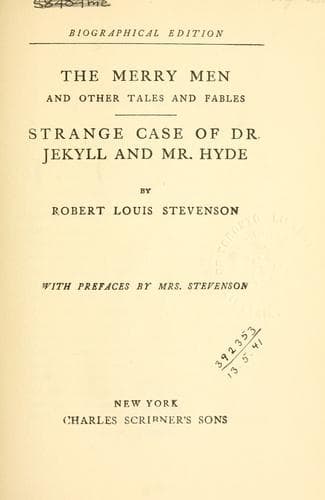
The Merry Men, and Other Tales and FablesStevenson, Robert Louis
History
The Merry Men, and Other Tales and Fables
Stevenson, Robert Louis
Boys -- Fiction; Great Britain -- History -- 19th century -- Fiction; Paranormal fiction; Treasure troves -- Fiction
She had drawn towards the door as she spoke, her rich voice sounding
softer and farther away; and with the last word she was gone, and I lay
alone in the moonlit chamber. What I might have done had not I lain
bound by my extreme weakness, I know not; but as it was there fell upon
me a great and blank despair. It was not long before there shone in at
the door the ruddy glimmer of a lantern, and Felipe coming, charged me
without a word upon his shoulders, and carried me down to the great
gate, where the cart was waiting. In the moonlight the hills stood out
sharply, as if they were of cardboard; on the glimmering surface of the
plateau, and from among the low trees which swung together and sparkled
in the wind, the great black cube of the residencia stood out bulkily,
its mass only broken by three dimly lighted windows in the northern
front above the gate. They were Olalla’s windows, and as the cart
jolted onwards I kept my eyes fixed upon them till, where the road
dipped into a valley, they were lost to my view forever. Felipe walked
in silence beside the shafts, but from time to time he would cheek the
mule and seem to look back upon me; and at length drew quite near and
laid his hand upon my head. There was such kindness in the touch, and
such a simplicity, as of the brutes, that tears broke from me like the
bursting of an artery.
“Felipe,” I said, “take me where they will ask no questions.”
He said never a word, but he turned his mule about, end for end,
retraced some part of the way we had gone, and, striking into another
path, led me to the mountain village, which was, as we say in Scotland,
the kirkton of that thinly peopled district. Some broken memories dwell
in my mind of the day breaking over the plain, of the cart stopping, of
arms that helped me down, of a bare room into which I was carried, and
of a swoon that fell upon me like sleep.
The next day and the days following the old priest was often at my side
with his snuff-box and prayer book, and after a while, when I began to
pick up strength, he told me that I was now on a fair way to recovery,
and must as soon as possible hurry my departure; whereupon, without
naming any reason, he took snuff and looked at me sideways. I did not
affect ignorance; I knew he must have seen Olalla. “Sir,” said I, “you
know that I do not ask in wantonness. What of that family?”
He said they were very unfortunate; that it seemed a declining race,
and that they were very poor and had been much neglected.
“But she has not,” I said. “Thanks, doubtless, to yourself, she is
instructed and wise beyond the use of women.”
“Yes,” he said; “the Senorita is well-informed. But the family has been
neglected.”
“The mother?” I queried.
“Yes, the mother too,” said the Padre, taking snuff. “But Felipe is a
well-intentioned lad.”
“The mother is odd?” I asked.
“Very odd,” replied the priest.
Public-domain text, read in full here on John Shaqi.
Reviews
Reviews
No reviews yet
Be the first to share your thoughts on this work.
Elsewhere in the archive
Join the Discussion
Join the discussion
Sign in to leave a comment or review.
Sign InorCreate an account