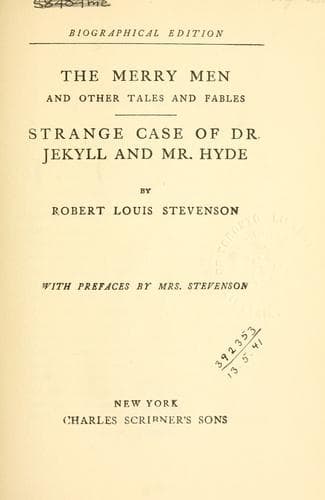
The Merry Men, and Other Tales and FablesStevenson, Robert Louis
History
The Merry Men, and Other Tales and Fables
Stevenson, Robert Louis
Boys -- Fiction; Great Britain -- History -- 19th century -- Fiction; Paranormal fiction; Treasure troves -- Fiction
“You fret against the common law,” I said. “You rebel against the voice
of God, which he has made so winning to convince, so imperious to
command. Hear it, and how it speaks between us! Your hand clings to
mine, your heart leaps at my touch, the unknown elements of which we
are compounded awake and run together at a look; the clay of the earth
remembers its independent life and yearns to join us; we are drawn
together as the stars are turned about in space, or as the tides ebb
and flow, by things older and greater than we ourselves.”
“Alas!” she said, “what can I say to you? My fathers, eight hundred
years ago, ruled all this province: they were wise, great, cunning, and
cruel; they were a picked race of the Spanish; their flags led in war;
the king called them his cousin; the people, when the rope was slung
for them or when they returned and found their hovels smoking,
blasphemed their name. Presently a change began. Man has risen; if he
has sprung from the brutes, he can descend again to the same level. The
breath of weariness blew on their humanity and the cords relaxed; they
began to go down; their minds fell on sleep, their passions awoke in
gusts, heady and senseless like the wind in the gutters of the
mountains; beauty was still handed down, but no longer the guiding wit
nor the human heart; the seed passed on, it was wrapped in flesh, the
flesh covered the bones, but they were the bones and the flesh of
brutes, and their mind was as the mind of flies. I speak to you as I
dare; but you have seen for yourself how the wheel has gone backward
with my doomed race. I stand, as it were, upon a little rising ground
in this desperate descent, and see both before and behind, both what we
have lost and to what we are condemned to go farther downward. And
shall I—I that dwell apart in the house of the dead, my body, loathing
its ways—shall I repeat the spell? Shall I bind another spirit,
reluctant as my own, into this bewitched and tempest-broken tenement
that I now suffer in? Shall I hand down this cursed vessel of humanity,
charge it with fresh life as with fresh poison, and dash it, like a
fire, in the faces of posterity? But my vow has been given; the race
shall cease from off the earth. At this hour my brother is making
ready; his foot will soon be on the stair; and you will go with him and
pass out of my sight for ever. Think of me sometimes as one to whom the
lesson of life was very harshly told, but who heard it with courage; as
one who loved you indeed, but who hated herself so deeply that her love
was hateful to her; as one who sent you away and yet would have longed
to keep you for ever; who had no dearer hope than to forget you, and no
greater fear than to be forgotten.”
Public-domain text, read in full here on John Shaqi.
Reviews
Reviews
No reviews yet
Be the first to share your thoughts on this work.
Elsewhere in the archive
Join the Discussion
Join the discussion
Sign in to leave a comment or review.
Sign InorCreate an account