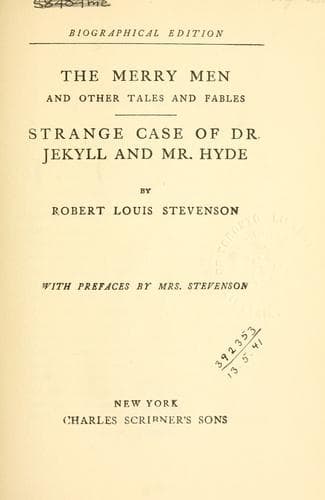
The Merry Men, and Other Tales and FablesStevenson, Robert Louis
History
The Merry Men, and Other Tales and Fables
Stevenson, Robert Louis
Boys -- Fiction; Great Britain -- History -- 19th century -- Fiction; Paranormal fiction; Treasure troves -- Fiction
On the back of that he went away, nor was he thenceforward so assiduous
in his visits; indeed, even when I began to get about again, he plainly
feared and deprecated my society, not as in distaste but much as a man
might be disposed to flee from the riddling sphynx. The villagers, too,
avoided me; they were unwilling to be my guides upon the mountain. I
thought they looked at me askance, and I made sure that the more
superstitious crossed themselves on my approach. At first I set this
down to my heretical opinions; but it began at length to dawn upon me
that if I was thus redoubted it was because I had stayed at the
residencia. All men despise the savage notions of such peasantry; and
yet I was conscious of a chill shadow that seemed to fall and dwell
upon my love. It did not conquer, but I may not deny that it restrained
my ardour.
Some miles westward of the village there was a gap in the sierra, from
which the eye plunged direct upon the residencia; and thither it became
my daily habit to repair. A wood crowned the summit; and just where the
pathway issued from its fringes, it was overhung by a considerable
shelf of rock, and that, in its turn, was surmounted by a crucifix of
the size of life and more than usually painful in design. This was my
perch; thence, day after day, I looked down upon the plateau, and the
great old house, and could see Felipe, no bigger than a fly, going to
and fro about the garden. Sometimes mists would draw across the view,
and be broken up again by mountain winds; sometimes the plain slumbered
below me in unbroken sunshine; it would sometimes be all blotted out by
rain. This distant post, these interrupted sights of the place where my
life had been so strangely changed, suited the indecision of my humour.
I passed whole days there, debating with myself the various elements of
our position; now leaning to the suggestions of love, now giving an ear
to prudence, and in the end halting irresolute between the two.
One day, as I was sitting on my rock, there came by that way a somewhat
gaunt peasant wrapped in a mantle. He was a stranger, and plainly did
not know me even by repute; for, instead of keeping the other side, he
drew near and sat down beside me, and we had soon fallen in talk. Among
other things he told me he had been a muleteer, and in former years had
much frequented these mountains; later on, he had followed the army
with his mules, had realised a competence, and was now living retired
with his family.
“Do you know that house?” I inquired, at last, pointing to the
residencia, for I readily wearied of any talk that kept me from the
thought of Olalla.
He looked at me darkly and crossed himself.
“Too well,” he said, “it was there that one of my comrades sold himself
to Satan; the Virgin shield us from temptations! He has paid the price;
he is now burning in the reddest place in Hell!”
Public-domain text, read in full here on John Shaqi.
Reviews
Reviews
No reviews yet
Be the first to share your thoughts on this work.
Elsewhere in the archive
Join the Discussion
Join the discussion
Sign in to leave a comment or review.
Sign InorCreate an account