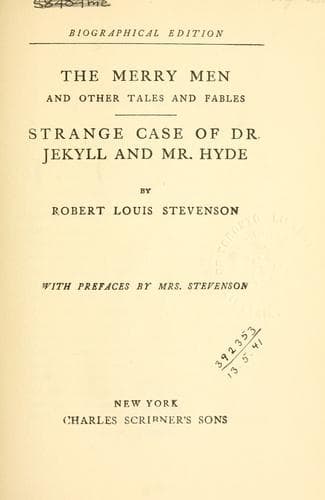
The Merry Men, and Other Tales and FablesStevenson, Robert Louis
History
The Merry Men, and Other Tales and Fables
Stevenson, Robert Louis
Boys -- Fiction; Great Britain -- History -- 19th century -- Fiction; Paranormal fiction; Treasure troves -- Fiction
A fear came upon me; I could answer nothing; and presently the man
resumed, as if to himself: “Yes,” he said, “O yes, I know it. I have
passed its doors. There was snow upon the pass, the wind was driving
it; sure enough there was death that night upon the mountains, but
there was worse beside the hearth. I took him by the arm, Senor, and
dragged him to the gate; I conjured him, by all he loved and respected,
to go forth with me; I went on my knees before him in the snow; and I
could see he was moved by my entreaty. And just then she came out on
the gallery, and called him by his name; and he turned, and there was
she standing with a lamp in her hand and smiling on him to come back. I
cried out aloud to God, and threw my arms about him, but he put me by,
and left me alone. He had made his choice; God help us. I would pray
for him, but to what end? there are sins that not even the Pope can
loose.”
“And your friend,” I asked, “what became of him?”
“Nay, God knows,” said the muleteer. “If all be true that we hear, his
end was like his sin, a thing to raise the hair.”
“Do you mean that he was killed?” I asked.
“Sure enough, he was killed,” returned the man. “But how? Ay, how? But
these are things that it is sin to speak of.”
“The people of that house . . . ” I began.
But he interrupted me with a savage outburst. “The people?” he cried.
“What people? There are neither men nor women in that house of Satan’s!
What? have you lived here so long, and never heard?” And here he put
his mouth to my ear and whispered, as if even the fowls of the mountain
might have over-heard and been stricken with horror.
What he told me was not true, nor was it even original; being, indeed,
but a new edition, vamped up again by village ignorance and
superstition, of stories nearly as ancient as the race of man. It was
rather the application that appalled me. In the old days, he said, the
church would have burned out that nest of basilisks; but the arm of the
church was now shortened; his friend Miguel had been unpunished by the
hands of men, and left to the more awful judgment of an offended God.
This was wrong; but it should be so no more. The Padre was sunk in age;
he was even bewitched himself; but the eyes of his flock were now awake
to their own danger; and some day—ay, and before long—the smoke of that
house should go up to heaven.
Public-domain text, read in full here on John Shaqi.
Reviews
Reviews
No reviews yet
Be the first to share your thoughts on this work.
Elsewhere in the archive
Join the Discussion
Join the discussion
Sign in to leave a comment or review.
Sign InorCreate an account